
Do Charitable Donations Reduce State Taxes?
A State-by-State Guide to Charitable Deductions and Credits (as of December 2025)
Not tax advice. This article provides general educational information. For advice about your situation, talk with a qualified tax professional. IRS rules can change, and your facts matter.
If you donate to charity and prepare your own taxes using TurboTax or similar software, you may have noticed something confusing:
Your charitable donations reduced your federal taxes,
but your state taxes barely moved — or didn’t change at all.
This often leads people to assume that states don’t offer charitable tax benefits.
That assumption is wrong.
According to authoritative state-by-state analysis from the U.S. Charitable Gift Trust (January 2025), most states provide a measurable tax benefit for charitable contributions — but not always in the same way as the federal government.
This guide explains:
- How charitable donations reduce state taxes
- Why the benefit differs by state
- What mechanism your state uses (deduction, credit, or subtraction)
- Why TurboTax shows what it shows
This article is current as of December 2025.
The Core Idea Most Articles Get Wrong
At the federal level, charitable giving is simple:
- Itemize → charitable donations reduce taxable income
At the state level, charitable tax benefits exist — but they are delivered through different mechanisms, depending on the state.
States use three primary mechanisms:
- Charitable deductions (reduce taxable income)
- Charitable tax credits (reduce tax owed, dollar-for-dollar)
- State-specific subtractions or adjustments (state-only income reductions)
Many other articles collapse these into a misleading “yes/no” answer.
This article does not.
Why State Charitable Tax Benefits Matter
The US Charitable Gift Trust calculates a maximum state/local charitable tax benefit for nearly every state with an income tax.
That number reflects:
- how the state treats charitable contributions, and
- the state’s tax rate structure
In plain English:
Charitable giving can meaningfully reduce your state tax bill — if you understand how your state applies the benefit.
This is especially important in high-population, high-tax states, where state tax savings can rival or exceed federal savings over time.
Deduction vs Credit vs Subtraction (Plain English)
Charitable deduction
- Reduces state taxable income
- Savings depend on your state tax rate
Example:
$5,000 deduction × 6% state tax rate = $300 tax savings
Charitable tax credit
- Reduces state tax owed, dollar-for-dollar
- Often limited to specific programs or charities
Example:
$500 credit = $500 less state tax owed
State-specific subtraction
- Reduces state taxable income even if federal itemization rules differ
- Common in states that “decouple” from federal itemization
All three are real tax benefits.
Important Federal Rule About State Credits (Still in Effect)
If you receive a state tax credit for a charitable contribution, the IRS requires that your federal charitable deduction be reduced by the value of that credit.
This rule was finalized by the IRS and remains in effect as of December 2025.
TurboTax applies this automatically — which often surprises taxpayers who expected to deduct the full donation federally.
TurboTax Callout: “Why Didn’t My State Taxes Change?”
If TurboTax shows:
- Federal tax ↓
- State tax →
The most common reasons are:
- Your state provides a credit instead of a deduction
- Your state allows deductions only under specific conditions
- Your state uses a state-only subtraction
- You did not qualify for a program-specific credit
This is expected behavior, not a software error.
Do Charitable Donations Reduce State Taxes?
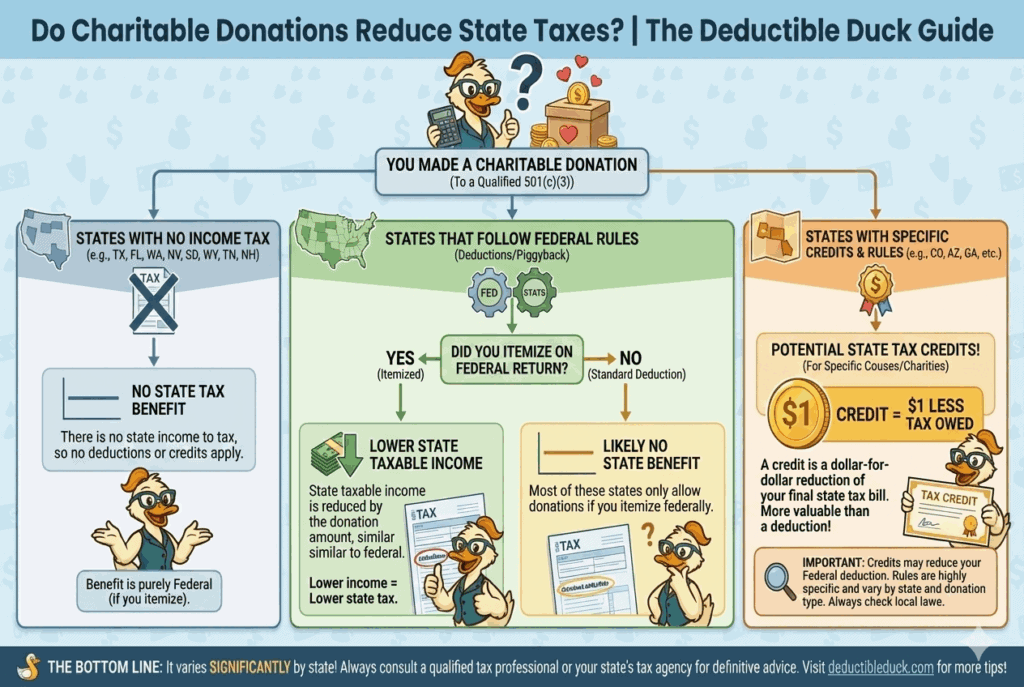
Yes — charitable donations can reduce state taxes, but the benefit depends entirely on your state’s tax laws.
Unlike federal taxes, states do not follow one uniform rule. Instead, states provide tax benefits for charitable giving in one of three ways:
- Charitable deductions (reduce state taxable income)
- Charitable tax credits (reduce state tax owed, dollar-for-dollar)
- State-specific subtractions or adjustments (state-only income reductions)
Some states offer no charitable tax benefit at all, even though charitable donations still reduce federal taxes.
This is why many taxpayers see their federal tax go down, but their state tax stay the same after entering charitable donations in TurboTax.
Are Charitable Contributions Considered a Deduction for State and Federal Income Taxes?
Charitable contributions are always considered a deduction for federal income tax purposes if you itemize.
At the state level, the answer depends on where you live:
- Some states allow the same deduction you take federally
- Some states replace deductions with tax credits
- Some states do not allow charitable deductions or credits at all
As a result:
- A donation may reduce federal tax only
- Or reduce both federal and state tax
- Or reduce state tax via a credit instead of a deduction
This difference is driven by state law, not tax software.
Here’s a short infographic summarizing these rules so far:
Which States Allow Charitable Deductions?
Many states allow charitable deductions — but not all.
The table below summarizes which states allow a charitable deduction, use tax credits instead, or provide no state tax benefit for charitable contributions.
How to Use the State Jump Table Below
The table below is a navigation index.
- Find your state
- In the right column, click the link “Jump to details”
- You’ll jump to a dedicated section answering the question:
Are charitable deductions allowed in <State>?
Each section explains:
- the exact mechanism your state uses
- what that means for your state return
- why TurboTax behaves the way it does
State Charitable Tax Treatment Summary
| State | State Tax Benefit for Charitable Giving |
|---|---|
| Alabama | Deduction Jump to details |
| Alaska | No income tax Jump to details |
| Arizona | Tax credits Jump to details |
| Arkansas | Deduction Jump to details |
| California | Deduction (with limits) Jump to details |
| Colorado | Credits / adjustments Jump to details |
| Connecticut | None Jump to details |
| Delaware | None Jump to details |
| Florida | No income tax Jump to details |
| Georgia | Deduction Jump to details |
| Hawaii | Deduction Jump to details |
| Idaho | Deduction Jump to details |
| Illinois | None Jump to details |
| Indiana | Deduction (limited) Jump to details |
| Iowa | Deduction Jump to details |
| Kansas | Deduction Jump to details |
| Kentucky | Deduction Jump to details |
| Louisiana | Tax credits Jump to details |
| Maine | Deduction Jump to details |
| Maryland | Deduction (with limits) Jump to details |
| Massachusetts | Deduction (with limits) Jump to details |
| Michigan | Deduction Jump to details |
| Minnesota | Deduction (with limits) Jump to details |
| Mississippi | Deduction Jump to details |
| Missouri | Deduction Jump to details |
| Montana | Deduction Jump to details |
| Nebraska | Deduction Jump to details |
| Nevada | No income tax Jump to details |
| New Hampshire | None Jump to details |
| New Jersey | None Jump to details |
| New Mexico | Tax credits Jump to details |
| New York | Deduction (with limits) Jump to details |
| North Carolina | None Jump to details |
| North Dakota | Deduction Jump to details |
| Ohio | Tax credits Jump to details |
| Oklahoma | Limited / program-based Jump to details |
| Oregon | Deduction (state & local) Jump to details |
| Pennsylvania | None Jump to details |
| Rhode Island | None Jump to details |
| South Carolina | Tax credits Jump to details |
| South Dakota | No income tax Jump to details |
| Tennessee | No income tax Jump to details |
| Texas | No income tax Jump to details |
| Utah | Tax credits Jump to details |
| Vermont | Deduction Jump to details |
| Virginia | Tax credits Jump to details |
| Washington | No income tax Jump to details |
| West Virginia | Deduction Jump to details |
| Wisconsin | Deduction (with limits) Jump to details |
| Wyoming | No income tax Jump to details |
| District of Columbia | Deduction (with limits) Jump to details |
Why This Matters for TurboTax and DIY Filers
If you’re using TurboTax or another DIY tax program:
- The software is not deciding whether your state allows deductions
- It is simply following your state’s rules
- Seeing no state tax change after entering donations is often correct
Understanding your state’s treatment explains:
- why the state number didn’t move
- whether a credit applies instead
- and whether donation tracking still matters (it often does)
Start Tracking Your Donations Now
Enter those valuable donations year-round and export an IRS-friendly report when you’re ready to file, just like ItsDeductible. Only $29.99/year
State-Specific Explanations
Are Charitable Deductions Tax Deductible in Alabama?
Yes. Alabama allows a charitable contribution deduction for individual income tax purposes when the taxpayer itemizes on the Alabama return. Qualifying charitable contributions reduce Alabama taxable income and generally follow federal definitions of eligible charities, contribution types, and documentation requirements.
Alabama does not impose a separate state-specific limitation regime for charitable deductions beyond its itemization requirement. As a result, taxpayers who itemize federally and at the state level will usually see charitable deductions flow through cleanly to the Alabama return.
Are Charitable Deductions Tax Deductible in Alaska?
Not applicable. Alaska does not impose a state income tax. Charitable contributions do not affect Alaska state taxes, though federal tax benefits still apply.
Are Charitable Deductions Tax Deductible in Arizona?
No general deduction, but substantial charitable tax credits are available.
Arizona does not allow a broad charitable contribution deduction against state taxable income. Instead, it uses dollar-for-dollar tax credits for donations to specific state-approved organizations, including Qualifying Charitable Organizations (QCOs) and Qualifying Foster Care Charitable Organizations (QFCOs).
These credits directly reduce Arizona tax owed and are among the most generous state-level charitable incentives in the country. However, because they are credits, the value of any Arizona credit claimed reduces the federal charitable deduction for the same contribution.
For TurboTax users, this often explains why the federal deduction appears smaller than expected after entering an Arizona credit donation. This is not a software error; it reflects required federal coordination rules.
Are Charitable Deductions Tax Deductible in Arkansas?
Yes. Arkansas allows a charitable contribution deduction for individual income tax purposes. Taxpayers who itemize may deduct qualifying charitable contributions, generally following federal rules regarding eligible organizations, contribution limits, and documentation.
Arkansas does not replace the deduction with credits for most general charitable giving, making it relatively straightforward for itemizers.
Are Charitable Deductions Tax Deductible in California?
Yes, but subject to important state-specific limitations.
California allows charitable contribution deductions for itemizers, reducing California taxable income. However, California applies its own limitation rules to itemized deductions, including charitable contributions, at higher income levels. These limitations can significantly reduce the usable value of the deduction for higher-income taxpayers.
In addition, California limits cash charitable deductions to 50% of federal AGI, rather than the federal 60% limit. This means that even when a donation is fully deductible federally, part of it may be deferred or limited for California purposes.
For TurboTax users, California is one of the most common states where:
- the federal charitable deduction looks large, but
- the state benefit is smaller than expected.
That outcome reflects California law, not a calculation error.
Are Charitable Deductions Tax Deductible in Colorado?
No general deduction, but credits and state-specific adjustments apply.
Colorado does not allow a broad charitable contribution deduction that mirrors the federal itemized deduction. Instead, charitable tax benefits are delivered through program-specific tax credits and certain state-specific subtractions or adjustments, depending on the nature of the contribution.
Because the mechanism varies by program, Colorado taxpayers may see charitable benefits reflected as credits rather than deductions. This explains why Colorado charitable benefits often appear differently on the state return than on the federal return.
Are Charitable Deductions Tax Deductible in Connecticut?
No general charitable deduction.
Connecticut does not allow a general charitable contribution deduction or subtraction for individual income tax purposes. Federal charitable deductions do not flow through to the Connecticut return.
As a result, Connecticut taxpayers frequently see federal tax savings from charitable giving with no corresponding reduction in Connecticut state taxes.
Are Charitable Deductions Tax Deductible in Delaware?
No. Delaware does not allow a charitable contribution deduction or credit for individual income tax purposes. Charitable contributions do not reduce Delaware taxable income.
Are Charitable Deductions Tax Deductible in Florida?
Not applicable. Florida does not impose a state income tax. Charitable contributions do not affect Florida state taxes.
Are Charitable Deductions Tax Deductible in Georgia?
Yes, with direct conformity to federal itemization.
Georgia allows a charitable contribution deduction and generally conforms to federal itemized charitable contribution rules. Taxpayers who itemize may deduct qualifying charitable contributions, reducing Georgia taxable income.
Georgia does not substitute credits for deductions for most charitable giving, which makes charitable deductions relatively predictable for Georgia itemizers. TurboTax users typically see state and federal charitable deductions align closely in Georgia.
Are Charitable Deductions Tax Deductible in Hawaii?
Yes, with high potential state impact.
Hawaii allows a charitable contribution deduction for individual income tax purposes. Because Hawaii has relatively high marginal tax rates, charitable deductions can produce meaningful state tax savings.
However, Hawaii applies its own state-specific rules and limits, which can cause the state deduction to differ from the federal amount in certain cases. Taxpayers with large donations should expect Hawaii’s calculation to follow state law rather than simply mirroring the federal return.
Are Charitable Deductions Tax Deductible in Idaho?
Yes. Idaho allows charitable contribution deductions and conforms to federal itemization for charitable contributions. Qualifying donations reduce Idaho taxable income.
Idaho does not impose a separate charitable credit regime for general donations, keeping the treatment relatively straightforward for itemizers.
Are Charitable Deductions Tax Deductible in Illinois?
No — and this is a major outlier.
Illinois does not allow a charitable contribution deduction or credit for individual income tax purposes, despite having a state income tax. Federal charitable deductions do not reduce Illinois taxable income.
This makes Illinois one of the most common “surprise states” for TurboTax users. It is entirely normal to see:
- a federal tax reduction from charitable giving, and
- no change in Illinois state tax.
This outcome reflects Illinois law, not a filing error.
Are Charitable Deductions Tax Deductible in Indiana?
Yes, with state-specific limits.
Indiana allows a charitable contribution deduction, but it applies state-specific caps and limits that differ from federal rules. As a result, the deductible amount for Indiana purposes may be lower than the federal deduction.
TurboTax users often notice this difference when large charitable donations are involved. Indiana’s treatment is deduction-based, not credit-based, but it is not a pure mirror of the federal calculation.
Are Charitable Deductions Tax Deductible in Iowa?
Yes. Iowa allows a charitable contribution deduction and generally conforms to federal charitable contribution rules for itemizers. Qualifying donations reduce Iowa taxable income.
Are Charitable Deductions Tax Deductible in Kansas?
Yes. Kansas allows charitable contribution deductions and follows federal itemized charitable contribution rules. Qualifying donations reduce Kansas taxable income.
Are Charitable Deductions Tax Deductible in Kentucky?
Yes. Kentucky allows a charitable contribution deduction and conforms to federal charitable contribution treatment for itemizers.
Are Charitable Deductions Tax Deductible in Louisiana?
No general deduction, but significant charitable tax credits are available.
Louisiana does not allow a broad charitable deduction. Instead, it offers charitable tax credits for donations to approved programs, particularly in education and community development.
These credits reduce Louisiana tax owed directly. Because they are credits, they reduce the federal charitable deduction for the same contribution, which often explains differences between state and federal results in tax software.
Are Charitable Deductions Tax Deductible in Maine?
Yes. Maine allows charitable contribution deductions and generally conforms to federal itemized charitable contribution rules.
Are Charitable Deductions Tax Deductible in Maryland?
Yes, with meaningful state impact and income-based limits.
Maryland allows a charitable contribution deduction for itemizers and generally conforms to federal charitable contribution rules. Because Maryland’s state and local tax rates can be substantial, charitable giving can meaningfully reduce state tax liability.
However, Maryland applies its own limitation rules at higher income levels, which can reduce the effective value of itemized deductions. Taxpayers with large donations may see state benefits capped or phased down relative to the federal deduction.
Are Charitable Deductions Tax Deductible in Massachusetts?
Yes, and one of the most impactful states for charitable deductions.
Massachusetts allows a charitable contribution deduction for individual income tax purposes. Because of Massachusetts’ tax structure, charitable deductions can produce significant state tax savings, particularly for consistent donors.
Massachusetts applies its own limitation framework, which can cause the deductible amount to differ from the federal return. TurboTax users should expect Massachusetts to calculate charitable deductions independently rather than simply copying the federal figure.
Are Charitable Deductions Tax Deductible in Nebraska?
Yes. Nebraska allows a charitable contribution deduction for individual income tax purposes. Taxpayers who itemize may deduct qualifying charitable contributions, generally following federal definitions of eligible charities and documentation requirements.
Nebraska conforms closely to federal itemization, so charitable deductions usually flow through cleanly for itemizers.
Are Charitable Deductions Tax Deductible in Nevada?
Not applicable. Nevada does not impose a state income tax. Charitable contributions do not affect Nevada state taxes.
Are Charitable Deductions Tax Deductible in New Hampshire?
Generally no. New Hampshire does not tax earned income (wages and salaries), and charitable deductions do not apply to its limited tax base. As a result, charitable contributions do not meaningfully reduce New Hampshire individual income taxes.
Are Charitable Deductions Tax Deductible in New Jersey?
No — and this is a frequent point of confusion.
New Jersey does not allow a charitable contribution deduction or credit for individual income tax purposes. Even if you itemize federally and receive a large federal charitable deduction, that deduction does not flow through to the New Jersey return.
For TurboTax users, this is one of the most common “why didn’t my state tax change?” scenarios. The outcome reflects New Jersey law, not a software issue.
Are Charitable Deductions Tax Deductible in New Mexico?
No general deduction, but charitable tax credits are available.
New Mexico does not allow a broad charitable deduction against state taxable income. Instead, it offers charitable tax credits for donations to approved programs, including certain educational and community foundations.
These credits reduce New Mexico tax owed directly. Because they are credits, the amount claimed must reduce the federal charitable deduction for the same donation.
Are Charitable Deductions Tax Deductible in New York?
Yes, but subject to income-based itemized deduction limitations.
New York allows a charitable contribution deduction for itemizers, reducing New York taxable income. However, New York applies itemized deduction limitation rules that can reduce the value of charitable deductions as New York AGI increases.
For residents of New York City or Yonkers, local income taxes mean charitable deductions can still have meaningful combined state and local impact — but the deduction may be capped or phased down at higher income levels.
TurboTax users often see strong federal benefits with more limited New York benefits due to these state-specific limitation rules.
Are Charitable Deductions Tax Deductible in North Carolina?
No. North Carolina does not allow a charitable contribution deduction or credit for individual income tax purposes. Federal charitable deductions do not reduce North Carolina taxable income.
This makes North Carolina another common “expectation mismatch” state for taxpayers accustomed to federal itemization.
Are Charitable Deductions Tax Deductible in North Dakota?
Yes. North Dakota allows a charitable contribution deduction and generally conforms to federal itemized charitable contribution rules. Qualifying donations reduce North Dakota taxable income.
Are Charitable Deductions Tax Deductible in Ohio?
No general deduction, but limited charitable tax credits apply.
Ohio does not allow a broad charitable deduction against state taxable income. Instead, it offers specific charitable tax credits, primarily for donations to approved scholarship-granting organizations and similar programs.
These credits reduce Ohio tax owed directly and are often capped. Because Ohio’s benefit is credit-based, the federal charitable deduction must be reduced by the value of any credit received.
Are Charitable Deductions Tax Deductible in Oklahoma?
No general deduction. Oklahoma does not broadly allow charitable deductions for individual income tax purposes, though limited program-specific credits may be available in certain cases.
Federal charitable deductions do not automatically reduce Oklahoma taxable income.
Are Charitable Deductions Tax Deductible in Oregon?
Yes, with significant state and local variation.
Oregon allows charitable contribution deductions that reduce Oregon taxable income. In addition, certain counties impose local income taxes, which means charitable deductions can have combined state and local tax effects depending on where you live.
Taxpayers in areas such as the Portland metro region may see larger total tax benefits than those elsewhere in the state.
Are Charitable Deductions Tax Deductible in Pennsylvania?
No — Pennsylvania is a strict non-conformity state.
Pennsylvania does not allow a charitable contribution deduction or credit for individual income tax purposes. Federal charitable deductions do not reduce Pennsylvania taxable income.
This result surprises many taxpayers because Pennsylvania has a flat income tax, but charitable deductions are simply not part of its tax structure.
Are Charitable Deductions Tax Deductible in Rhode Island?
No general deduction. Rhode Island does not broadly allow charitable contribution deductions for individual income tax purposes. Federal charitable deductions generally do not reduce Rhode Island taxable income.
Are Charitable Deductions Tax Deductible in South Carolina?
No general deduction, but charitable tax credits are available.
South Carolina does not allow a broad charitable deduction. Instead, it offers charitable tax credits for donations to approved programs, including education-related initiatives.
These credits reduce South Carolina tax owed directly and can be more valuable than deductions, though they reduce the federal charitable deduction for the same contribution.
Are Charitable Deductions Tax Deductible in South Dakota?
Not applicable. South Dakota does not impose a state income tax. Charitable contributions do not affect South Dakota state taxes.
Are Charitable Deductions Tax Deductible in Tennessee?
Not applicable. Tennessee does not impose a state income tax on wages and salaries. Charitable contributions do not affect Tennessee state taxes.
Federal charitable deductions still apply, but there is no state-level impact.
Are Charitable Deductions Tax Deductible in Texas?
Not applicable. Texas does not impose a state income tax. Charitable contributions do not reduce Texas state taxes.
This often surprises new residents coming from high-tax states, but Texas has no mechanism—deduction or credit—for individual charitable giving at the state level.
Are Charitable Deductions Tax Deductible in Utah?
No general deduction, but charitable tax credits are available.
Utah does not allow a broad charitable contribution deduction against state taxable income. Instead, it offers charitable tax credits for donations to approved organizations.
These credits reduce Utah tax owed directly and are subject to caps. Because the benefit is credit-based, the value of the credit must reduce the federal charitable deduction for the same donation.
Are Charitable Deductions Tax Deductible in Vermont?
Yes. Vermont allows a charitable contribution deduction and generally conforms to federal itemized charitable contribution rules. Qualifying donations reduce Vermont taxable income when the taxpayer itemizes.
Are Charitable Deductions Tax Deductible in Virginia?
No general deduction, but significant charitable tax credits are available.
Virginia does not allow a broad charitable deduction for individual income tax purposes. Instead, it offers charitable tax credits for donations to approved programs, including education, community development, and neighborhood assistance initiatives.
These credits reduce Virginia tax owed directly and can be more valuable than deductions. As with other credit-based systems, the federal charitable deduction must be reduced by the amount of credit received.
For TurboTax users, Virginia often shows state benefits as credits rather than deductions, which can feel unfamiliar but is correct under Virginia law.
Are Charitable Deductions Tax Deductible in Washington?
Not applicable. Washington does not impose a state income tax. Charitable contributions do not affect Washington state taxes.
(Separate Washington business taxes and capital gains taxes have different rules, but charitable deductions do not apply to individual wage income.)
Are Charitable Deductions Tax Deductible in West Virginia?
Yes. West Virginia allows a charitable contribution deduction and generally conforms to federal charitable contribution rules for itemizers. Qualifying donations reduce West Virginia taxable income.
Are Charitable Deductions Tax Deductible in Wisconsin?
Yes, with state-specific limits.
Wisconsin allows charitable contribution deductions, but it applies state-specific caps and limitations that can differ from federal rules. As a result, the deductible amount for Wisconsin purposes may be lower than the federal deduction.
TurboTax users often notice this difference when entering large charitable donations.
Are Charitable Deductions Tax Deductible in Wyoming?
Not applicable. Wyoming does not impose a state income tax. Charitable contributions do not affect Wyoming state taxes.
Are Charitable Deductions Tax Deductible in the District of Columbia?
Yes, but subject to income-based limitations.
The District of Columbia allows a charitable contribution deduction for itemizers, reducing DC taxable income. However, DC applies income-based limitation rules to itemized deductions, including charitable contributions.
As income rises above certain thresholds, the usable value of the charitable deduction may be reduced. This can cause the DC benefit to appear smaller than expected, even when the federal deduction is fully allowed.
For TurboTax users, this explains why charitable deductions may phase down on the DC return despite remaining intact federally.
What This Means in Practice (The Takeaway Most People Miss)
The idea that “states don’t care about charitable donations” is simply false.
Based on authoritative state-by-state analysis (including the US Charitable Gift Trust, January 2025):
- Most states with an income tax provide a measurable charitable tax benefit
- That benefit may come through:
- a deduction
- a credit
- or a state-specific subtraction
- High-tax states often provide meaningful state savings, especially over multiple years
- States without income tax are the exception, not the rule
The real challenge isn’t whether the benefit exists — it’s understanding which mechanism your state uses and tracking donations correctly so you can claim it.
Why This Increases the Value of Proper Donation Tracking
State tax treatment makes accurate, item-level tracking more valuable, not less:
- Credits require precise donation categorization
- State deductions often require itemization even when federal rules change
- FMV documentation still matters for non-cash donations
- Audit exposure is federal, even when state benefits are limited
This is exactly why the loss of ItsDeductible created friction — not because tax benefits disappeared, but because the rules stayed complex.
Further Reading
Start Tracking Your Donations Now
Enter those valuable donations year-round and export an IRS-friendly report when you’re ready to file, just like ItsDeductible. Only $29.99/year