
Charitable Deductions in 2026: What You Need to Know

Not tax advice. This article is general educational information. For advice about your situation, talk with a qualified tax professional. IRS rules can change, and your facts matter.
Status note: This article reflects IRS guidance and enacted law current as of December 2025. Tax rules change. Always verify against the latest IRS publications before filing.
2026 Charitable Donations: What Really Changed, What Didn’t, and What to Do Now
If you’ve been donating to charity for years and itemizing your deductions, the headlines around charitable donations in 2026 probably feel louder—and more confusing—than helpful.
Add to that the shutdown of ItsDeductible, and many long-time donors are asking the same questions:
- Am I still getting the same tax benefit for giving?
- Did the rules change enough that I need to rethink how I donate?
- How do I track charitable donations now that ItsDeductible is gone?
Let’s slow this down and walk through it plainly, without tax jargon, political noise, or unnecessary complexity.
TL;DR:
In 2026, itemized charitable deductions are reduced by a small AGI floor, non-itemizers get a limited cash-only deduction, and the core IRS rules for charitable donations stayed the same. Former ItsDeductible users still need careful tracking—especially for non-cash donations.
The Big Picture for Charitable Donations in 2026
Only two meaningful things changed in 2026.
Most of the charitable donation rules you’ve followed for years did not.
What changed:
- Itemizers now face a small floor before charitable deductions count
- Non-itemizers can claim a limited charitable deduction again (cash only)
Everything else—fair market value rules, receipts, Form 8283, appraisal thresholds—stayed the same.
Old Rules vs. 2026 Rules (Side-by-Side)
Here’s a clear comparison of how charitable donation rules worked before—and how they work now.
| Topic | Before 2026 | Starting in 2026 |
|---|---|---|
| Itemized charitable deductions | Fully deductible (subject to AGI limits) | Deductible only above 0.5% of AGI |
| Non-itemizer charitable deduction | Mostly unavailable | Up to $1,000 single / $2,000 MFJ (cash only) |
| Cash donation AGI limits | Up to 60% of AGI | Unchanged |
| Non-cash donation rules | FMV required | Unchanged |
| $250 written acknowledgment rule | Required | Still required |
| Form 8283 threshold | Non-cash totals over $500 | Still required |
| Appraisals for high-value items | Required in some cases | Still required |
| Tracking tools | ItsDeductible widely used | ItsDeductible shut down — replacement needed (we recommend Deductible Duck!) |
The takeaway is simple: the tax math changed slightly, but the recordkeeping did not.
What Changed for Charitable Donations in 2026
1. The 0.5% AGI Floor for Itemized Charitable Deductions
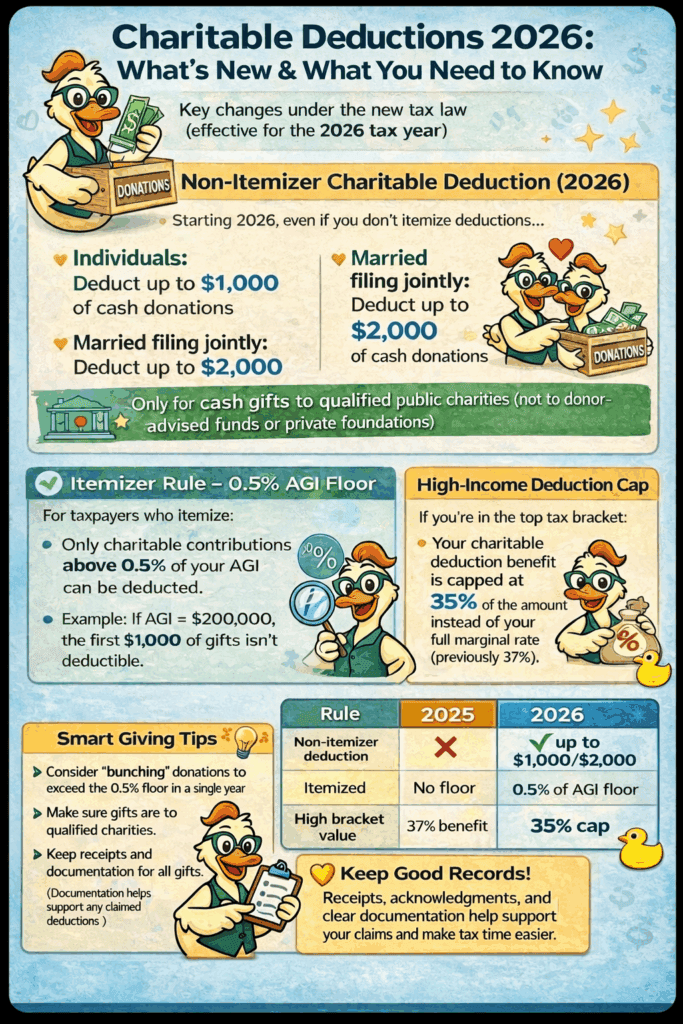
If you itemize, charitable deductions now only apply to the portion of your giving that exceeds 0.5% of your Adjusted Gross Income (AGI).
That sounds technical, but the effect is usually modest.
Example
- AGI: $200,000
- 0.5% floor: $1,000
- Total charitable donations: $8,000
Only the amount above $1,000 counts.
So instead of deducting $8,000, you deduct $7,000.
This doesn’t eliminate the deduction—it simply trims the first small slice.
Why this matters:
For consistent donors, accurate tracking matters more than ever, because partial deductions are now common.
2. A Charitable Deduction for Non-Itemizers (Cash Only)
Starting in 2026, taxpayers who do not itemize can deduct charitable donations again:
- Up to $1,000 (single filers)
- Up to $2,000 (married filing jointly)
Important limitations:
- Applies to cash donations only
- Donations must go to IRS-qualified charities
- Non-cash donations (clothing, household goods, etc.) do not qualify for this deduction
This helps modest cash donors—but it does not replace itemizing for people who regularly donate non-cash items.
What Did Not Change for Charitable Donations
This is where many people get tripped up. Despite the headlines, the foundation stayed the same.
Qualified charities are still required
Donations must be made to IRS-qualified organizations. Gifts to individuals, GoFundMe campaigns, or informal help are not deductible.
Fair market value rules for non-cash donations are unchanged
Non-cash donations still require reasonable fair market value (FMV) under IRS rules.
In plain English:
What a willing buyer would reasonably pay for the item in its current condition.
This is the same standard many people relied on when using ItsDeductible—and it’s the same standard tools like Deductible Duck are designed around today.
Documentation requirements did not move
- Donations of $250 or more still require a written acknowledgment from the charity
- Non-cash donations totaling over $500 still require Form 8283
- Higher-value property may still require a qualified appraisal
AGI percentage limits still apply
Traditional limits (for example, 60% of AGI for cash to public charities) still apply after the new 0.5% floor is met.
Start Tracking Your Donations Now
Enter those valuable donations year-round and export an IRS-friendly report when you’re ready to file, just like ItsDeductible. Only $29.99/year
What This Means for Real People
If You Itemize (Most Former ItsDeductible Users)
- You should still track charitable donations carefully
- Small donations may no longer reduce taxes dollar-for-dollar
- Larger or “bunched” donation years matter more
- Clean records matter more if part of your deduction gets trimmed
Bottom line:
Itemizing still makes sense for many donors—especially those with non-cash donations.
What has changed is that you need a reliable replacement for ItsDeductible to keep those records organized year-round. For many former ItsDeductible users, Deductible Duck is the most direct successor because it preserves the same discipline while working with today’s tax software.
If You Don’t Itemize
- You may still receive a modest tax benefit for cash donations
- Keep receipts anyway—rules change, and habits matter
- Non-cash donations should still be tracked in case you itemize later
If You Donate Non-Cash Items
This is where the loss of ItsDeductible hit hardest.
Nothing about non-cash charitable donation rules became simpler in 2026—but they also didn’t get worse.
You still need:
- Reasonable FMV
- Clear item descriptions
- Condition notes
- Donation dates and charities
- Awareness of Form 8283 thresholds
The difference now is how you track all of this. Many donors have turned to Deductible Duck because it fills the same role ItsDeductible once did—without spreadsheets or last-minute scrambling.
Here’s an infographic summarizing what we’ve covered so far:
A Simple 2026-Ready Charitable Donation Checklist
Whether you itemize or not, these steps will keep you organized and audit-safe:
- Track charitable donations as they happen
- Separate cash and non-cash donations
- Record how FMV was determined for non-cash items
- Save receipts and written acknowledgments
- Monitor non-cash totals for Form 8283
- Sign up for Deductible Duck
This is exactly the routine ItsDeductible supported—and exactly what donors still need going forward.
Helpful Guides (If You Want to Go Deeper)
- Fair market value basics for charitable donations
- Donating Clothing or Valuing Household Goods
- Understanding Form 8283
- How to keep audit-safe charitable donation records
These are worth bookmarking once and reusing every year.
Final Reminder
Tax laws evolve, but good charitable donation recordkeeping never goes out of style.
This article reflects rules current as of December 2025.
Before filing your 2026 return, confirm details using:
If you’re replacing ItsDeductible, the goal isn’t to outsmart the tax code—it’s to document your generosity clearly, conservatively, and once, so tax time stays boring.
That’s still achievable in 2026.
Start Tracking Your Donations Now
Enter those valuable donations year-round and export an IRS-friendly report when you’re ready to file, just like ItsDeductible. Only $29.99/year