
Deductable or Deductible? Here’s What It Means
Not tax advice. This article provides general educational information. For advice about your situation, talk with a qualified tax professional. IRS rules can change, and your facts matter.
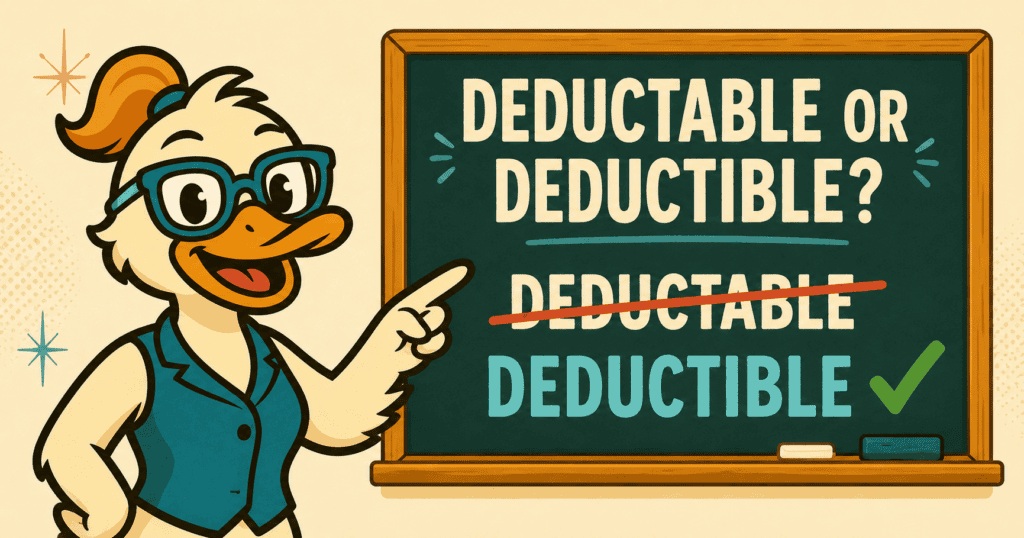
If you typed “deductable” into a search bar, you’re in the right place. The word you’re looking for is spelled deductible. The version with an “a” (deductable) is one of the most common spelling mix-ups in money and taxes. Plenty of people write it that way, so you’re far from alone.
The spelling is the easy part. What most people really want to know is what a deductible actually is and how it affects the money in their pocket. The word gets used in two main ways: with taxes and with insurance. We’ll cover the spelling difference, and then the tax side next, since that’s what most people are after, then the insurance side below.
What you’ll find on this page
- Deductable or deductible: which spelling is right?
- What “tax deductible” means
- A tax deduction example with donations
- Standard deduction vs itemizing
- What a deductible means in insurance
- Higher deductible or lower deductible?
- Common types of insurance deductibles
- Deductible vs out-of-pocket maximum
- Common questions
Deductable or deductible: which spelling is right?
The correct spelling is deductible, with an “i” before the “ble.” It comes from the word “deduct,” which means to take an amount away from a total.
It’s easy to see why “deductable” feels right. Lots of English words end in “able,” like “comfortable” or “reliable.” But “deductible” follows a different pattern, the same one you see in “credible” and “responsible.” So when you write it down, just remember the “i.”
Both spellings point to the same idea, so don’t worry if you’ve been writing it the other way.
What “tax deductible” means
When something is “tax deductible,” it means you can subtract that expense from your income when you figure out your taxes.
Lowering your taxable income can lower the amount of tax you owe. That’s why people pay attention to which expenses are deductible.
Here’s a simple example. Say you earned $50,000 in a year and you’ve got $5,000 in deductible expenses. You might be able to subtract that $5,000, which leaves $45,000 as the income you actually get taxed on. You’re taxed on a smaller number, so your tax bill goes down.
Not every expense counts, and the rules can get detailed. But the basic idea stays the same: a deductible expense shrinks the income you pay tax on.
A tax deduction example with donations
One of the most common tax deductions is for charitable donations. If you give money or goods to a qualified charity, the value of that gift might be deductible.
Picture this. Over the year you drop off bags of clothes, some furniture, and a few household items at a local charity. Each of those donations has a value. Added together, they can become a deduction that lowers your taxable income.
To claim it, two things matter:
- The donation has to go to a qualified organization.
- You need records that show what you gave and what it was worth.
This is where a lot of people leave money on the table. They donate all year, then forget the details by tax time. Keeping a running list of your donations and their values makes the deduction easy to claim and easy to back up if anyone asks.
That’s exactly what Deductible Duck is built for. You log each donation as you make it, get a fair value for the items, and keep clean records all in one place. When tax time comes around, your list is ready and you’re not digging through old receipts trying to remember what that box of clothes was worth.
Start Tracking Your Donations Now
Enter those valuable donations year-round and export an IRS-friendly report when you’re ready to file, just like ItsDeductible. Only $29.99/year
Standard deduction vs itemizing
There’s one more tax piece worth knowing. When you file, you usually choose between two paths:
- The standard deduction. A flat amount the government lets almost everyone subtract, no receipts needed.
- Itemizing. Adding up your individual deductible expenses, like donations and certain other costs, and subtracting that total instead.
You pick whichever one is bigger, because that’s the one that saves you the most. If your itemized expenses add up to more than the standard deduction, itemizing makes sense. If not, the standard deduction is the simpler choice. Keeping good records during the year is what lets you compare the two and choose with confidence.
What a deductible means in insurance
The other place you’ll hear “deductible” a lot is insurance. Here it means the amount you pay out of your own pocket before your insurance company starts paying.
Let’s say you’ve got car insurance with a $500 deductible. One day you back into a pole and the repair costs $2,000. Here’s how the bill splits up:
- You pay the first $500. That’s your deductible.
- Your insurance company pays the remaining $1,500.
The deductible is your share of the cost. Once you’ve paid it, your coverage kicks in and handles the rest, up to the limits of your policy.
If the repair had only cost $400, you’d pay the whole thing yourself. That’s because the cost never passed your $500 deductible, so the insurance company didn’t have to pay anything.
This is the trade-off built into almost every insurance plan. You agree to cover a set amount on your own, and the company covers the bigger costs.
Higher deductible or lower deductible?
When you pick an insurance plan, you usually get to choose your deductible. This choice changes your monthly bill, which is called your premium.
Here’s the general rule:
- A higher deductible means a lower monthly premium. You pay less each month, but you pay more out of pocket when something goes wrong.
- A lower deductible means a higher monthly premium. You pay more each month, but less out of pocket when you file a claim.
So which one’s better? It depends on your situation. If you rarely file claims and you’ve got some savings set aside, a higher deductible can save you money over time. If you’d struggle to cover a big surprise bill, a lower deductible gives you more cushion when you need it.
There’s no single right answer. The best choice is the one that fits your budget and how much risk you’re comfortable with.
Common types of insurance deductibles
The word shows up across different kinds of insurance. Here are the ones you’re most likely to meet.
Health insurance deductible. This is the amount you pay for covered medical care before your health plan starts paying its share. For example, with a $1,500 deductible, you pay your own medical bills until they add up to $1,500. After that, your plan begins covering costs, though you might still owe smaller amounts called copays or coinsurance.
Auto insurance deductible. This kicks in when your car is damaged and you file a claim. You pay the deductible, and your insurer covers the rest of the repair.
Homeowners insurance deductible. This works the same way for damage to your home, like from a storm or a break-in. You pay your deductible, and your policy handles the rest of the covered loss.
One thing to keep in mind with health plans: not every cost counts toward your deductible the same way, and some services might be covered before you meet it. It’s worth reading your plan details so you know what applies.
Deductible vs out-of-pocket maximum
People often mix up the deductible with another term: the out-of-pocket maximum. They’re not the same thing.
- The deductible is what you pay before your insurance starts helping.
- The out-of-pocket maximum is the most you’ll pay in a year. Once you hit it, your insurance covers 100 percent of covered costs for the rest of the year.
Think of the deductible as the starting line and the out-of-pocket maximum as the ceiling. Your deductible payments count toward that ceiling, along with your copays and coinsurance.
Common questions about deductable/deductible
Deductible is the correct spelling. Deductable is a common misspelling of the same word.
It means an expense you can subtract from your income, which can lower the tax you owe.
Often yes, if you give to a qualified charity and keep records of what you donated and what it was worth.
It’s the amount you pay for covered medical care before your health plan starts paying its share.
A higher deductible lowers your monthly premium but costs more when you file a claim. A lower deductible costs more each month but less when you need care. The right pick depends on your budget and how often you expect to file claims.
The bottom line on deductable vs. deductible
The word is spelled deductible, not deductable, but the spelling isn’t what matters most. What matters is the idea behind it: a deductible is the amount you cover yourself before someone else pays, whether that’s a smaller tax bill at the end of the year or an insurance company picking up a claim.
On the tax side, knowing what’s deductible helps you keep more of your money. If donations are part of your year, a simple record of what you gave and what it was worth turns those gifts into a deduction you can actually claim. A little tracking during the year saves a lot of guesswork at tax time, and that’s where Deductible Duck can do the heavy lifting for you. Track your donations as you go, and your deduction is ready when you need it.
Start Tracking Your Donations Now
Enter those valuable donations year-round and export an IRS-friendly report when you’re ready to file, just like ItsDeductible. Only $29.99/year