
Car Donation Tax Deduction: 2026 Rules & How Much You Get
Car donation tax deduction: how much you’ll really get (and how not to lose it)
Quick answer: The car donation tax deduction usually equals the price the charity sells your car for, which often lands well below the Kelley Blue Book number. If it sells for $500 or less, you can deduct up to $500. The charity must send you Form 1098-C showing the sale amount, and you’ll file Form 8283 with your return. Full details below, including three exceptions that let you deduct fair market value.
There’s a car in your driveway that nobody drives anymore. Maybe it was your late father’s Buick. Maybe it’s the minivan that hauled kids to soccer for a decade and now just collects pollen. Selling it feels like a hassle: the listing, the strangers, the test drives, the haggling. So the radio ad sounds perfect. “Donate your car! Free pickup! Maximum tax deduction!”
Donating a car can be a fine thing to do. But those ads leave out most of the story, and the part they leave out is the part that decides whether you get a $2,800 deduction, a $650 deduction, or no deduction at all. The rules changed back in 2005 after the IRS caught too many people deducting showroom prices for cars with bad transmissions, and they changed again for tax year 2026. Most of what your neighbor remembers about car donations is out of date.
This guide walks through the whole thing in plain English: what you can actually deduct, the paperwork that protects you, the mistakes that cost people their deductions, and one piece of math almost nobody runs that might change your plan entirely.
The short version: three buckets
Every car donation lands in one of three buckets, and the bucket decides your deduction.
Bucket 1: The charity sells your car for $500 or less. You can deduct the car’s fair market value up to $500. This is where most old beaters end up. A car that goes to auction for $340 still gets you up to a $500 deduction, as long as it was honestly worth at least that much.
Bucket 2: The charity sells your car for more than $500. Your deduction is the gross proceeds, meaning the actual sale price at auction rather than the Blue Book value or what you believe the car was worth. If your $4,000 car sells for $1,900, your deduction is $1,900.
Bucket 3: One of three exceptions applies. If the charity keeps the car and uses it, materially improves it, or gives it to a needy person as part of its mission, you can deduct the car’s full fair market value. More on these below, because they’re the difference between a small deduction and a real one.
The reason for this system is worth thirty seconds of history, because it explains why car donations get more IRS attention than a bag of sweaters ever will.
Why the rules got strict: a short history
Before 2005, car donors claimed fair market value on the honor system. You said your car was worth $3,000, and that was that. The honor system lost, badly. Cars with slipping transmissions and flood damage were routinely deducted at clean-retail prices, and government studies found charities sometimes netting pennies on each claimed dollar. So the American Jobs Creation Act of 2004 rewired the whole thing: for cars sold by the charity, the deduction became the actual sale price, reported to you and to the IRS on Form 1098-C.
The effect was immediate. IRS data shows the number of vehicle donation claims fell about 67% from 2004 to 2005, and the dollars claimed fell about 80%, from roughly $2.4 billion to under half a billion. That cliff isn’t a sign that Americans stopped being generous. It’s the before-and-after picture of inflated values leaving the system.
Two lessons hide in that history. First, the paper trail is not optional decoration; it is the deduction. Second, the IRS has institutional memory about vehicle donations, which is why your folder of evidence matters more here than for any other donation you’ll make this year.
Step 1: Pick a real charity (and ask one rude question)
The deduction only exists if the organization is a qualified 501(c)(3) charity. Churches and most well-known nonprofits qualify. That heavily advertised “car donation program” with the catchy jingle? Maybe, maybe not. Some are charities. Some are for-profit companies that collect cars, sell them, and pass a slice of the money to a charity you’ve never heard of.
Before you hand over the keys, do three things:
- Verify the charity. Look it up in the IRS Tax Exempt Organization Search at irs.gov. If it’s not there, your donation is not deductible, full stop.
- Check its reputation. The BBB’s Give.org, Charity Navigator, and GuideStar all rate charities for free. A charity that won’t explain its mission or send you information is telling you something.
- Ask the rude question. Many charities use a for-profit towing and auction company to run their car programs, and the split between the company and the charity varies widely. Massachusetts state guidance tells donors to ask exactly this: how is the money from your car split between the charity and the for-profit company? A good program answers without flinching. Your deduction doesn’t depend on the answer, but your generosity does.
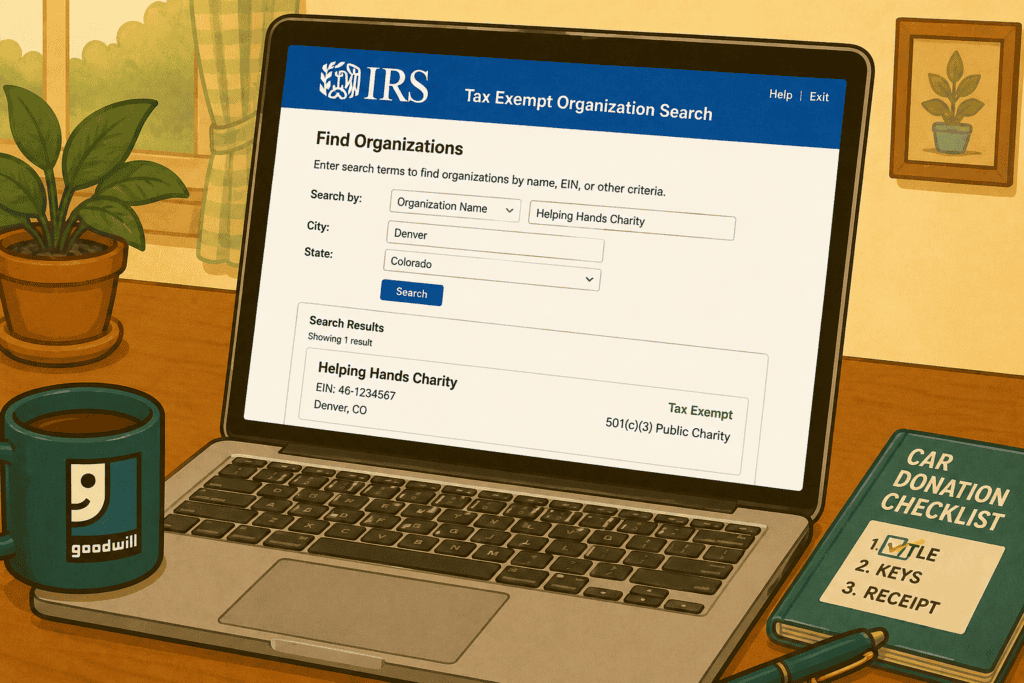
One more caution for the skeptics (you’ve earned it): a charity name that sounds almost like a famous one is a classic setup. “Veterans of America Foundation” is not “Disabled American Veterans.” Check the exact legal name and the EIN; a thirty-second lookup beats a familiar-sounding logo every time.
Step 2: Understand what you’ll actually deduct
This is where the radio ads and reality part ways. Let’s take the three buckets one at a time, with real numbers.
The sale-price rule (most donations)
Most charities don’t keep cars. They send them to auction, often within days. When that happens, the law limits your deduction to the gross proceeds of the sale. Auction prices are wholesale prices, and wholesale is a cold shower. A 2011 Accord that would fetch $4,500 in a private sale might hammer for $1,700 at a dealer auction. Your deduction: $1,700.
You’ll find out the number when the charity sends you Form 1098-C, which it must do within 30 days of the sale. The same form goes to the IRS, which is why creative rounding doesn’t work here.
The $500-or-less rule
If your car sells for $500 or less, the rules soften. You may deduct the fair market value up to $500, or the sale price, whichever treatment applies, without needing the sale figure to carry the whole load. In plain terms: the old Taurus that auctioned for $220 can still be a $500 deduction if it was honestly worth $500. This is the one place the law gives the donor the benefit of the doubt, and it covers a lot of driveway veterans.
The three exceptions that allow fair market value
The law carves out three cases where you deduct the car’s full fair market value instead of the auction price. IRS Publication 4303, the donor’s guide to vehicle donations, spells them out:
- Significant intervening use. The charity keeps the car and actually uses it for its work. A van that delivers meals for two years. A sedan a job-training program uses to drive clients to interviews. Occasional errands don’t count; the use has to be real and substantial.
- Material improvement. The charity makes major repairs or improvements before selling, the kind that significantly increase the car’s value. A new coat of wax doesn’t qualify. A rebuilt engine might.
- Sale to a needy individual. The charity gives the car, or sells it far below market value, to a person in need, and doing so is part of the charity’s mission. Programs that put reliable cars under low-income working families fall here.
If one of these applies, the charity must say so, in writing, in your acknowledgment. You can’t claim the exception because you assume the charity kept the car. The certification is the ticket. If getting the biggest deduction matters to you, ask the charity before you donate: “Will you sell my car at auction, or use it?” Programs built around the exceptions exist, and they’ll tell you proudly.
Step 3: Get fair market value right (the mistake that sinks audits)
When an exception applies, or your car lands in the $500-or-less bucket, you need the car’s fair market value. This is where more car-donation deductions go wrong than anywhere else.
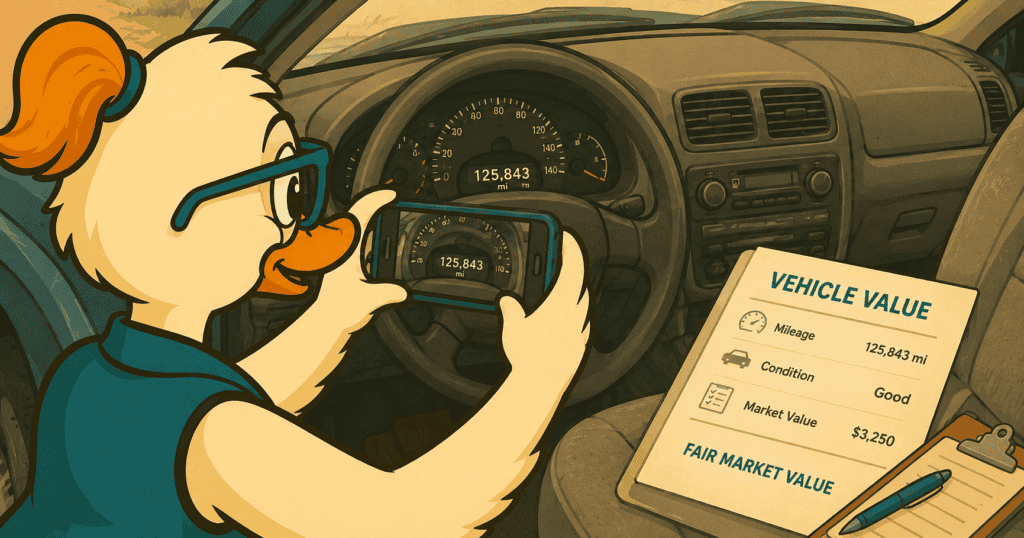
Fair market value is what a willing buyer would pay a willing seller, both knowing the facts. For a used car, that means the private-party price. The pricing guides you already know, like Kelley Blue Book, Edmunds, and the NADA guides, all publish private-party values. Use that column instead of “dealer retail,” and be honest about the condition rating.
Honesty about condition is the whole game. The guides ask whether your car is excellent, good, fair, or poor. The uncomfortable truth: almost no fifteen-year-old daily driver is “excellent.” Excellent means near showroom. If the AC is weak, the seats are worn, and there’s a door ding from the grocery store in 2019, you’re looking at fair. The IRS knows the difference, and Publication 4303 warns plainly that it will only allow a value that accounts for mileage and condition.
A practical method that holds up:
- Look up the private-party value for your exact year, make, model, trim, and mileage.
- Pick the condition level a stranger would pick rather than the one your memory picks.
- Print or screenshot the valuation page the day you donate. That printout, plus photos of the car inside and out, is your evidence.
- If you’re claiming more than $5,000, stop. That requires a written appraisal from a qualified appraiser, done before you file. Guides won’t cut it at that level.
Try it with real numbers. Say you’re donating a 2016 Outback with 121,000 miles to a program that gives cars to working families, so fair market value applies. The guide shows private-party values of $7,900 excellent, $6,700 good, $5,400 fair. The car runs well but has a cracked taillight, tired struts, and a cargo area that hosted a golden retriever for nine years. An honest stranger calls that fair: $5,400. Because that’s above $5,000, you’d need a qualified appraisal to claim it, so you face a choice: pay for a qualified appraisal to defend the full $5,400, or claim a smaller amount that stays under the appraisal line. Both are legal; claiming less than fair market value is always allowed. Run that math before you file; after filing is too late. (And notice the trap in reverse: rounding yourself up to “good” to feel better about the car is the kind of optimism the IRS has seen a million times.)
Step 4: The paperwork trail, start to finish
Car donations involve more paperwork than dropping bags at Goodwill, but none of it is hard. Think of it as four documents and two phone calls.
The title
Sign the title over to the charity (or its authorized agent) at pickup, and fill in the mileage. Never leave the buyer line blank, no matter how nicely the tow driver asks. An open title means the car is legally still yours. If it gathers parking tickets, blows through a toll, or worse, gets in an accident before the paperwork catches up, those problems find their way back to you. Massachusetts state guidance is blunt about this: take responsibility for transferring the title at the time of the donation, and keep copies of both sides.
While you’re at it: take your plates off if your state requires it, return them or transfer them per your DMV’s rules, file any release-of-liability form your state offers, and cancel the insurance once the car is gone. Two phone calls, ten minutes, and you’re clean.
The written acknowledgment and Form 1098-C
For any car deduction over $500, you need a written acknowledgment from the charity, and the timing is specific. IRS Publication 4303 sets two clocks:
- If the charity sells the car, the acknowledgment must come within 30 days of the sale, showing the gross proceeds.
- If the charity certifies an exception (it will use or improve the car, or pass it to a needy person), the acknowledgment must come within 30 days of your donation, stating that certification.
Most charities handle this with Form 1098-C, which doubles as the acknowledgment. It shows your name, taxpayer ID, the vehicle identification number, and either the sale proceeds or the exception certification. File it with your tax records the day it arrives, because no acknowledgment means no deduction over $500, even when everything else was done perfectly.
Form 8283
If your total noncash donations for the year top $500, and a donated car almost guarantees they will, you’ll attach Form 8283 to your return. Section A covers items up to $5,000. Over $5,000 means Section B, the appraisal, and a signature from the charity. Your tax software will walk you through it and will ask for the details on your 1098-C. If you file on paper, attach Copy B of the 1098-C to your return.
The shoebox (or the app)
Keep the title copies, the 1098-C, your valuation printout, your photos, and the pickup receipt together. An audit on a car donation is really an audit of this folder. If the folder is complete, the audit is boring, which is the outcome you want. This is also precisely the kind of record-keeping a donation tracker does for you automatically, so nothing lives in a shoebox you can’t find in April.
Start Tracking Your Donations Now
Enter those valuable donations year-round and export an IRS-friendly report when you’re ready to file, just like ItsDeductible. Only $29.99/year
What actually happens to your car (and why the check is smaller than you’d think)
It helps to see the machine from the inside, because it explains the numbers on your 1098-C.
When you call most car donation lines, you’re often talking to a processing company hired by the charity. That company dispatches the tow truck, handles the title, and runs the car through a wholesale auto auction alongside trade-ins and fleet vehicles. Auctions move fast and pay wholesale, which is why a car with a $4,500 private-party value can sell in ninety seconds for $1,700. Out of that come towing costs, auction fees, and the processor’s cut. What remains goes to the charity.
None of this is a scandal by itself. Charities aren’t in the used-car business, and outsourcing the messy part is reasonable. But it explains two things donors find surprising: why your deduction (the gross sale price) is so much lower than the value guides suggested, and why the charity’s actual benefit can be lower still. It’s also why programs that keep and use vehicles, the exception programs, are worth seeking out when your car has real life left in it. The car does more good, and your deduction is bigger. That combination is rare in the tax code; take it where you find it.
One more piece of the machine: if a charity sells a vehicle it said it would keep, or sells any donated item valued over $5,000 within three years, it files Form 8282 with the IRS reporting the sale. The system checks itself. Numbers that were right on day one never have to survive a cross-examination later.
Special cases: leases, lost titles, dead batteries, and boats
A leased car can’t be donated. You don’t own it; the leasing company does. Buy out the lease first if the math makes sense, or skip it.
A car with a lost title usually can be donated, after a stop at the DMV. Most states will issue a duplicate title to the registered owner for a small fee, often same-week. Some donation programs say they’ll take cars without titles, but the clean path, and the one that fully detaches your liability, is getting the duplicate first. Budget one errand for it.
A car that doesn’t run is still donatable. Tow programs take non-runners every day. Just adjust your expectations to match: a dead car sells at auction for scrap-adjacent money, so you’re almost certainly in the $500-or-less bucket. That’s still a fine outcome for a car that was costing you registration fees and driveway space.
Boats, RVs, motorcycles, and even airplanes follow the same rules. The 1098-C system covers boats, RVs, and motorcycles the same way it covers cars. Same buckets, same exceptions, same paperwork. One wrinkle for boats and RVs: values swing more by season and region, so date your valuation evidence and pick the guide’s condition rating with extra honesty.
Recent repairs don’t carry over dollar-for-dollar. The $1,200 you spent on a new transmission last spring made the car sellable; it did not add $1,200 to its fair market value. Value the car as it sits, whole, against the private-party market. The receipts for major work are still worth keeping with your donation records, because they support the condition rating you chose.
A word about timing (and a strategy worth knowing)
The donation counts for the tax year you hand over the car and sign the title, even if the charity sells it months later. A December 30 pickup belongs to this year’s return; the auction can happen in February without changing that.
That timing rule opens a strategy older donors use well: bunching. If your itemized deductions hover just below the standard deduction line, donating the car in the same year you stack other giving, a January and a December church pledge, the big Goodwill cleanout, can push one year over the line so the donations actually count, while you take the standard deduction in the off years. With the standard deduction at $32,200 for couples in 2026, one well-timed vehicle donation is often the shove a bunching year needs. Sketch both years before you schedule the tow truck; an hour with a calculator can be worth several hundred dollars here.
2026 Quirks You Need To Know
Two tax law changes took effect for tax year 2026, and both matter to car donors.
First, the 0.5% floor. If you itemize, your charitable donations now only count to the extent they exceed 0.5% of your adjusted gross income. With an $80,000 AGI, your first $400 of donations earns you nothing; the deduction starts above that line. A donated car usually clears the floor with room to spare, but the floor shaves every itemizer’s total.
Second, the new non-itemizer deduction doesn’t cover cars. Starting in 2026, people who take the standard deduction can deduct up to $1,000 in charitable gifts ($2,000 for couples filing jointly). Here’s the catch: it covers cash donations only, and a donated car is property in the IRS’s eyes. If you don’t itemize, donating your car gets you a warm feeling and no tax deduction at all.
And most people don’t itemize. The 2026 standard deduction is $16,100 for singles and $32,200 for married couples filing jointly. Unless your mortgage interest, state and local taxes, and donations together beat those numbers, the car donation deduction is theoretical for you. Which brings us to the math almost nobody runs.
Do the math FIRST: donate the car, or sell it and donate cash?
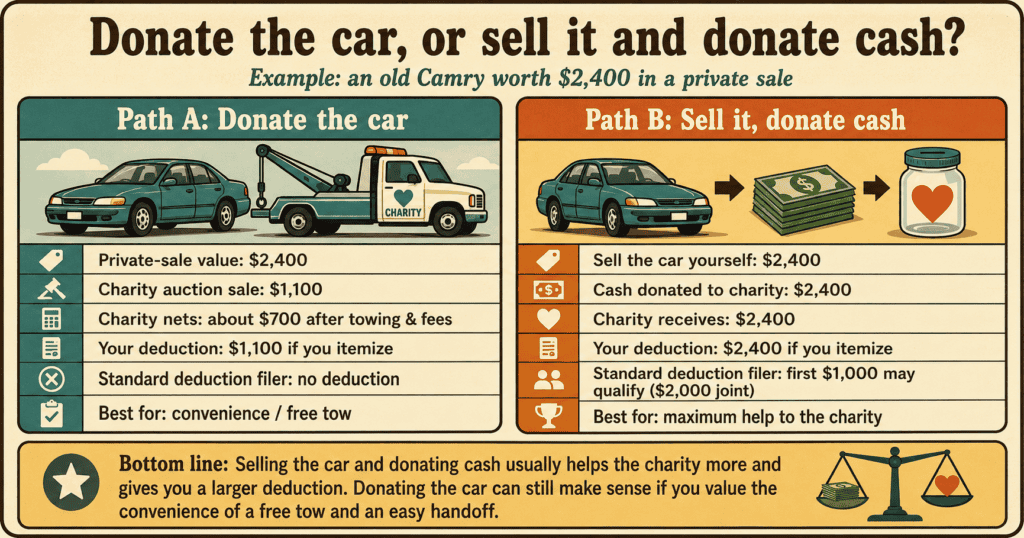
Say your old Camry would bring $2,400 in a private sale, and you want to support your local food bank. You have two good options.
Path A: Donate the car. The charity’s auction partner sells it for $1,100 (remember, auctions pay wholesale). The charity nets maybe $700 after towing and fees. Your Form 1098-C says $1,100. If you itemize, you deduct $1,100 minus whatever the 0.5% floor eats. If you take the standard deduction, you deduct nothing.
Path B: Sell the car yourself, donate the cash. You pocket $2,400, donate $2,400 in cash. The charity gets more than three times as much money. And because cash donations qualify for the new non-itemizer deduction, even a standard-deduction filer gets a tax break on the first $1,000 ($2,000 joint). An itemizer deducts the full $2,400 against the same floor.
Path B wins on nearly every line, with one honest exception: your time. A private sale means listing, calls, and strangers. If the car barely runs, if the title is tangled, or if you simply do not want one more errand in your life, Path A’s free tow is worth real money too. There’s no shame in choosing convenience. Just choose it knowing the trade, because the radio ad will never lay it out for you.
Seven questions to ask before the tow truck comes
You’ll be on the phone with the donation program anyway to schedule pickup. Five extra minutes of questions can double what your donation accomplishes and protect your deduction. Here’s the script:
- “Are you the charity itself, or a company that processes donations for charities?” Either answer can be fine. You just want to know who you’re dealing with.
- “What’s the charity’s exact legal name and EIN?” Then check it in the IRS Tax Exempt Organization Search while you’re still on the phone. Legit programs rattle this off; evasive ones are telling you to hang up.
- “Will my car be sold at auction, or used by the charity?” This single question determines whether you get the auction price or fair market value. If your car runs well, it’s worth calling a second program to find one that keeps cars.
- “How is the sale money split between the charity and the processor?” You’re allowed to ask. Massachusetts’ consumer guidance tells donors to ask this very question.
- “How do you handle the title, and will your driver accept it signed over to the charity by name?” If anyone suggests leaving the title blank “to make it easier,” that’s your cue to pick a different program.
- “When will I receive my written acknowledgment or Form 1098-C?” Get the expected timing on record so you know when to follow up.
- “Do you handle my state’s release-of-liability filing, or do I?” Programs vary. Know before the car leaves, because the deadline in some states is short.
None of these questions is rude, whatever it feels like. You’re a donor doing diligence, and every reputable program has heard them a hundred times this month.
Don’t forget your state return
Federal rules get all the attention, but your state return may have its own opinion. Some states piggyback on your federal itemized deductions, so the car donation flows through automatically. Others have their own charitable deduction or credit rules, and a few offer nothing at all for donations. A handful require their own release-of-liability filing when a vehicle changes hands, which matters for your legal exposure even more than your taxes. Check your state’s revenue department page, or our guide to how charitable donations affect state taxes, before you assume the federal answer is the whole answer.
A start-to-finish example: Margaret’s Camry
Margaret is 68, retired, and files jointly with her husband, Frank. Their 2014 Camry has 148,000 miles, a solid engine, and a passenger door that whistles on the highway. They itemize because of medical expenses and property taxes.
In October, Margaret finds a local job-training charity through Give.org that uses donated cars to get clients to work. She confirms the charity in the IRS lookup, and the program tells her the Camry will go to a client family instead of to auction. That’s the needy-individual exception, so fair market value applies.
She looks up the private-party value: $4,100 in good condition, $3,300 in fair. The whistling door and the mileage make the honest call fair, so $3,300. She screenshots the valuation, photographs the car from all sides plus the odometer, and signs the title over at pickup, keeping copies. Within 30 days, the charity sends a written acknowledgment certifying the car will be given to a person in need as part of its mission.
At tax time, their software asks about the donation. They enter the acknowledgment details, complete Form 8283 Section A, and claim $3,300. Their AGI is $90,000, so the new 0.5% floor sets aside the first $450 of their total giving, which their combined donations clear easily. Total time spent on paperwork: under an hour. Deduction: intact and defensible.
Notice what Margaret didn’t do. She didn’t claim the $4,100 “good” value for a car with a whistling door. She didn’t take a tow-truck driver’s word that “you can write off five grand.” And she didn’t leave the title blank. Every step was ten minutes of care, and every step protected the whole deduction.
Six mistakes that cost people their car donation deduction
Claiming retail value. The number one error. Dealer retail includes the dealer’s profit, reconditioning, and warranty. Your deduction never gets to use it. Private-party value, honest condition, or the sale price on the 1098-C. Pick the one the law gives you.
Missing or ignored Form 1098-C. No written acknowledgment, no deduction over $500. Period. If 30 days pass after your donation window and nothing arrives, call the charity. Chasing that paper is worth more per minute than almost anything else you’ll do this year.
The blank title. Handing over a signed-but-open title feels easier, and some sloppy programs even prefer it. It leaves you legally attached to a car you no longer control. Fill in the charity’s name. Every time.
Donating to a sound-alike. If the “charity” isn’t in the IRS database, the deduction is zero no matter how sincere your intent or official their paperwork looked.
Missing December 31. The donation belongs to the year you deliver the car and sign it over. A December 30 pickup counts for this year even if the auction happens in February; a January 2 pickup waits for next year’s return.
Forgetting the deduction only works if you itemize. With the 2026 standard deduction at $16,100 single and $32,200 joint, many donors get no tax benefit from donating a vehicle. Run the sell-and-donate-cash math above before the tow truck comes, while every option is still open.
At tax time: what the software will ask you
Whether you use TurboTax, H&R Block, FreeTaxUSA, or a preparer, the interview follows the same path, and knowing it removes the April anxiety.
First, it asks whether you donated a vehicle and whether the charity sold it. Answer with your Form 1098-C in front of you. If box 4a is checked and a sale amount appears, that’s your deduction number (unless it’s $500 or less, in which case the software applies the up-to-$500 rule for you). If the exception box is checked instead, the software will ask for your fair market value, and this is where your valuation printout earns its keep. Enter the number you documented, at the condition you documented.
Second, it fills out Form 8283 from your answers. You’ll be asked how you acquired the car (purchase, gift, inheritance), roughly when, and what you paid. Estimates are acceptable here for an old car; “purchased, 2014, about $24,000” is a fine answer for the Camry you bought new. The software carries everything to the right lines.
Third, if you e-file, the 1098-C details are transmitted with your return; keep the paper original with your records. If you file by mail, physically attach Copy B of the 1098-C. Either way, nothing else needs to be sent in unless you’re over $5,000, where the appraisal and the charity’s signature on Section B come into play.
That’s the whole ceremony. Fifteen minutes, if the folder is in order. The folder is always the hard part, and you built it when you sold the car.
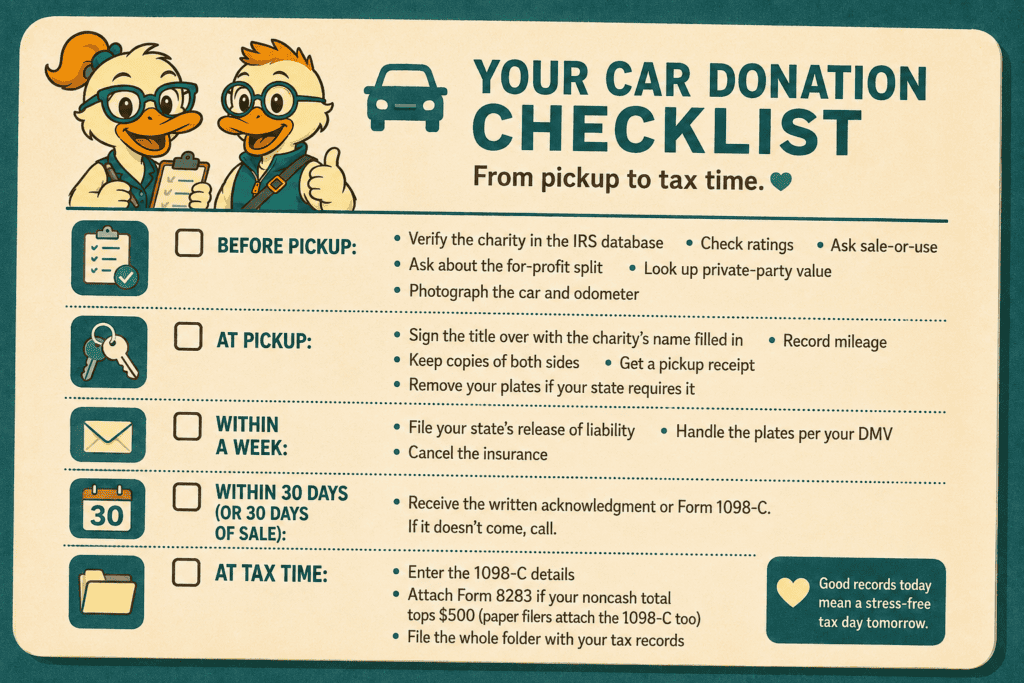
Your car donation checklist
Before pickup: verify the charity in the IRS database, check ratings, ask sale-or-use, ask about the for-profit split, look up private-party value, photograph the car and odometer.
At pickup: sign the title over with the charity’s name filled in, record mileage, keep copies of both sides, get a pickup receipt, remove your plates if your state requires it.
Within a week: file your state’s release of liability, handle the plates per your DMV, cancel the insurance.
Within 30 days (or 30 days of sale): receive the written acknowledgment or Form 1098-C. If it doesn’t come, call.
At tax time: enter the 1098-C details, attach Form 8283 if your noncash total tops $500 (paper filers attach the 1098-C too), and file the whole folder with your tax records.
If you remember only five things
- Your deduction is the sale price. In most cases, whatever the charity’s auction brings, shown on your Form 1098-C, is your number.
- The three exceptions are worth hunting for. A charity that uses your car, improves it, or gives it to a needy family earns you fair market value instead, and it must certify that in writing.
- Never hand over a blank title. Fill in the charity’s name before the tow truck leaves your driveway.
- Standard-deduction filers get no benefit from donating a car in 2026. The new non-itemizer deduction covers cash only, so consider selling the car and donating the money instead.
- The folder is the deduction. Title copies, the 1098-C, your valuation printout, your photos. When the folder is complete, everything else takes care of itself.
Common Questions people ask about car donation tax deductions
Only if you itemize, and even then the deduction is usually the auction price rather than the Blue Book value. If you take the standard deduction, donating a car brings no tax benefit at all in 2026. Selling the car and donating cash often helps both you and the charity more.
Your deduction is generally what the charity sells the car for. If it sells for $500 or less, you can deduct up to $500. If the charity uses the car, improves it, or gives it to a needy person, you can deduct fair market value. You need Form 1098-C and, over $500 total, Form 8283.
Compare the junkyard’s cash offer to your realistic deduction. A $400 junk check usually wins, because a $500 deduction returns only about $60 to $110 in real tax savings at typical rates. For a car with life left in it, a charity that gives cars to needy families can beat both options on meaning.
Whatever the charity sold it for, shown on your Form 1098-C. If it sold for $500 or less, up to $500. If a fair market value exception applies, the honest private-party value for its condition, with an appraisal required above $5,000.
Contact the charity; they’re required to provide it within 30 days of the sale (or of your donation, if an exception applies). Without a written acknowledgment you cannot claim a deduction over $500, so keep calling until it’s in your hands.
Vehicle donations get extra IRS attention because of past abuse, which is why the 1098-C system exists. A donation with matching paperwork, defensible values, and photos is routine. The audits that hurt are the ones where the claimed value has no evidence behind it.
No. The leasing company owns the car, so it isn’t yours to give. If you’re near the end of a lease with equity in the buyout, you could buy the car and then donate it, but run the numbers first; selling and donating cash usually works out better.
Yes. Most programs tow non-runners at no charge. Expect the $500-or-less bucket, since a dead car sells for scrap value, but that still beats paying to keep an immovable object insured and registered.
It depends on your state. Many states require you to remove the plates and either return them or transfer them to another vehicle, and several tie your release of liability to that step. Check your DMV’s donation or sale instructions; it’s the same process as selling the car privately.
Start Tracking Your Donations Now
Enter those valuable donations year-round and export an IRS-friendly report when you’re ready to file, just like ItsDeductible. Only $29.99/year