
Goodwill Donation Receipt & Tax ID: What the IRS Wants
Quick answer: To deduct a Goodwill donation at tax time, you need the Goodwill donation receipt from the store, your own list of the items with thrift-store values, and photos if you can get them. If your donated goods top $500 for the year, you also file IRS Form 8283. The tax ID number belongs to your local Goodwill, and the IRS form never even asks for it.

Not tax advice. This article is general educational information. For advice about your situation, talk with a qualified tax professional. IRS rules can change, and your facts matter.
You know the routine. You clean out a closet, load up the car, and pull around to the Goodwill donation door. The attendant takes your boxes and hands you a small paper receipt. You toss it in the glove box and forget about it until tax time.
Then April rolls around, and that little Goodwill donation receipt raises more questions than it answers. It’s blank, your tax software wants an EIN you’ve never heard of, and you wonder whether any of this is worth the trouble. It is, and none of it is hard.
How to get a Goodwill donation receipt
Every Goodwill will give you a receipt when you donate. At most locations, the attendant hands you a paper receipt on the spot. If they forget, just ask. There’s no minimum, and it costs nothing. The receipt shows the Goodwill location, the date, and a space to describe what you gave.
Many regions now issue Goodwill donation receipts digitally, and the setups vary. Goodwill Northern New England emails you a receipt from an online form. In North Georgia, the donation tracker lets you register with the receipt ID printed on your paper receipt, and it prints a yearly summary at tax time. Down in Southern California, staff enter your donation on an e-receipt system and email you an access code. If your region offers one of these, use it. A yearly summary is much harder to lose than a paper receipt.
One exception: unattended donation bins have nobody to hand you a receipt. The IRS allows this. Publication 526 says that when a receipt is impractical, your own written record can stand in. Note the date, place, and items, and keep that note with your tax papers. For anything sizable, donate where a person can hand you a receipt.
The blank receipt problem (and the two-minute fix)
The Goodwill donation receipt is mostly blank on purpose, which surprises people. The IRS rule is that the charity’s receipt describes what you gave and leaves the value blank. Figuring the value is your job. Goodwill’s receipts put it more bluntly, and some say IRS rules prohibit them from valuing your donation. Also, Goodwill Northern New England states plainly that it does not keep a copy of your receipt. Once you drive off, that receipt is the only one in existence.
So take two minutes before you leave the parking lot. Write your items on the receipt while your memory is fresh: 8 men’s dress shirts, 2 winter coats, 1 toaster, 3 board games. Then add two words to each line: the condition (good) and how you priced it (thrift shop). Those are the two things the IRS says your own records have to show.
Then snap a photo of the receipt with your phone. Better yet, photograph the items before you donate them. This is the IRS’s own advice. Publication 526 says to support your values with photographs, canceled checks, and purchase receipts. It also says to keep that evidence with your records. Don’t mail it in with your return. If the IRS ever asks, pictures of eight nice dress shirts settle the matter fast.
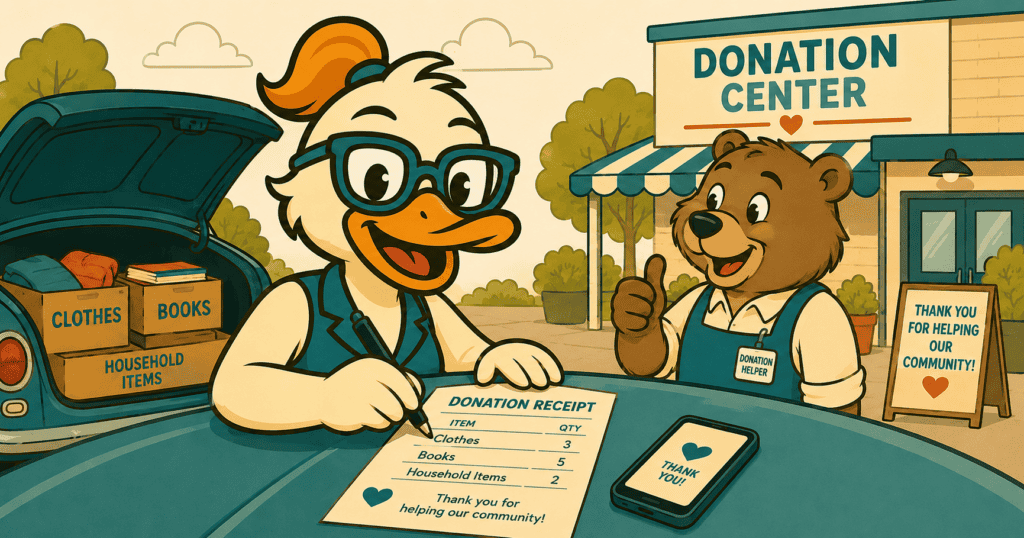
What the IRS needs when one trip is worth $250 or more
For a trip under $250, the Goodwill donation receipt plus your own list is enough. For a trip worth $250 or more, the IRS wants a written acknowledgment from the charity. The IRS acknowledgment rules say it must describe what you gave and include a line saying Goodwill gave you nothing in return. Most Goodwill receipts have that sentence printed on them. If yours doesn’t, ask the store for a letter or an email that says so. The IRS accepts email.
There’s a deadline, and it’s firm. Publication 1771 says you must have the acknowledgment by the day you file your return. Nobody can backdate one for you in May. The same publication says one year-end summary covering all your trips also works, which is exactly what the Goodwill donation tracker sites produce.
One more thing people get wrong: the $250 line applies to each trip. Three separate $200 trips are three separate donations, and the basic receipt covers each one. The IRS regulation says it in so many words: separate contributions under $250 are not added together, even if the year’s total passes $250. That’s a good reason to donate as you go. One giant haul puts everything in a single $250-plus trip.
Goodwill’s tax ID number: why there isn’t just one
There is no single tax ID number for Goodwill. Goodwill Industries International, the national office, has its own EIN (53-0196517), but that’s almost never the number you want. Goodwill is a network of 150 local organizations. Each one is its own independent charity with its own employer identification number, or EIN.
That means the right number depends on where you donated. A few real examples: Goodwill Central Coast in California uses 94-1254638. Goodwill Industries Inc. in Omaha uses 47-0378996. Goodwill Southern California uses 95-1641441. Same blue smiley logo, different charities, different numbers.
Why does the number matter at all? Some tax software asks for it when you enter a donation. The number is also how you confirm your local Goodwill is a qualified charity in the eyes of the IRS. The IRS form itself doesn’t ask for it.
How to find your local Goodwill’s EIN
Finding your number takes about two minutes. Work down this list:
- Check your receipt. Many regional Goodwills print their EIN right on the Goodwill donation receipt, in small print near the top or bottom.
- Check the local website. Search for your regional Goodwill (for example, Goodwill Omaha tax info). Most have a tax page that lists the EIN.
- Search it in Deductible Duck. Type Goodwill into the EIN search, then pick the one with your local address. It pulls from the official IRS database, with less digging. Set up your Deductible Duck account to try it.
- Use the IRS lookup tool. The Tax Exempt Organization Search finds it by name and state, and confirms the charity can receive deductible donations.
- Call the store. Staff hear this question all tax season, and they’ll be happy to help.
Write the number somewhere you’ll find it next year. It doesn’t change.
Two Goodwill websites publish the wrong EIN
One more reason to check: Goodwill websites sometimes copy each other’s tax pages. As of October 2026, the Goodwill Omaha and Goodwill Central Coast tax pages both tell donors to put 39-2040239 on Form 8283. That number belongs to Goodwill Retail Services Inc. in Milwaukee. Omaha’s own number is 47-0378996. If a Goodwill page gives you an EIN, run it through the IRS lookup and make sure the city matches the store you used.
Does the IRS even ask for the EIN?
The IRS form for donated goods, Form 8283, never asks for Goodwill’s EIN. Section A, the part almost everyone uses, wants the charity’s name and address. The only EIN box on the whole form is in Section B, and Goodwill fills that in itself when a single item tops $5,000. You need the EIN to look up your Goodwill in the IRS database, and some tax software asks for it. The IRS itself never does.
For the address, use the street address of the location where you actually dropped off your donation. Skip the national headquarters. If your donated goods for the year top $500, Form 8283 asks for the name and address of the organization that received them, and the IRS expects those details to match reality. Your receipt shows the location, which is one more reason that receipt matters.
The IRS paper trail: four levels
The IRS asks for more proof as the numbers get bigger. Think of it as four steps on a ladder. These rules come straight from Publication 526 and the Form 8283 instructions.
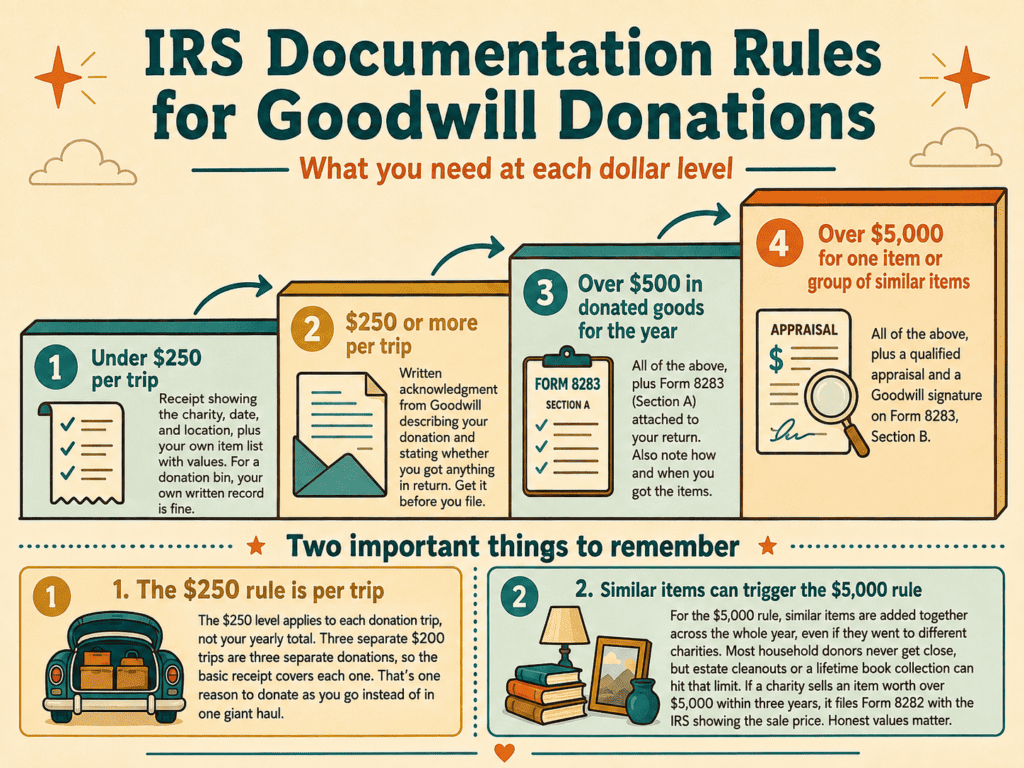
| Value of your donation | What the IRS wants from you |
|---|---|
| Under $250 per trip | A Goodwill donation receipt showing the charity, date, and location, plus your own item list with values and condition. (Your own written record is fine for a donation bin.) |
| $250 or more per trip | A written acknowledgment from Goodwill that describes your donation and says you got nothing in return. Have it before you file. |
| Over $500 in donated goods for the year | All of the above, plus Form 8283 (Section A) attached to your return. |
| Over $5,000 for one item or group of similar items | All of the above, plus a qualified appraisal and a Goodwill signature on Form 8283, Section B. |
Form 8283 has columns for when you bought each item, how you got it, and what you paid. People see those and panic. Relax: the IRS says you can leave all three blank for any item you’re deducting $500 or less for. For a normal Goodwill run, that’s every item. The form also asks how you came up with each value. For clothes and household goods, the IRS instructions give you the words to use: Thrift shop value. Our guide to Form 8283 walks through the rest of the form line by line.
One catch on that $5,000 line: similar items get added together for the whole year, even if they went to different charities. Most household donors never get close. But someone clearing out an estate, or donating a lifetime book collection in pieces, can hit it without realizing. And when a charity sells an item you reported in Section B within three years, it files Form 8282 with the IRS showing the actual sale price. That’s why honest values matter. The paperwork can catch up with wishful thinking.
The condition rule and what counts as a household item
The IRS only allows deductions for clothing and household items in good used condition or better. That worn-out recliner with the broken footrest? If Goodwill can’t sell it, you can’t deduct it. Note the condition of each item on your list. (A narrow exception exists for a single item over $500 with a qualified appraisal.) The everyday test is simple: if you’d hesitate to buy it at a thrift store, leave it off your list. Our guide to IRS rules for non-cash donations covers the fine print.
The good-used-condition rule covers clothes and household items. The IRS list of household items is short: furniture, electronics, appliances, and linens. Art, antiques, jewelry, and coin or stamp collections follow other rules. A costly piece from that group can need an appraisal. Don’t lump grandma’s silver in with the sweaters.
How to value what you gave
The standard is fair market value, which for used goods means roughly what a thrift store would charge. Publication 526 gives its own example. You paid $300 for a coat three years ago, and similar coats sell for $50 at the thrift store. Your deduction is $50. A gently used dress shirt might be a few dollars; a solid wood dresser might be $50 or more. Our Goodwill donation value guide lists typical prices, and our plain-English explainer on fair market value covers the idea behind them.
Two more things straight from the IRS: a formula like a third of what I paid is not an acceptable way to value household items, and photos are on the IRS’s own list of good evidence. If you donate a large number of the same item, say 60 shirts from a closed shop, the IRS values them at what 60 shirts would sell for together, which is less than 60 times the price of one.
Here’s a trick a longtime donor shared on Reddit, and it’s a good one: stop back at the store a few days after you donate and photograph similar items on the racks, price tags showing. Now your claimed values are backed by Goodwill’s own pricing. Hard to argue with that.
Three myths making the rounds online
Online forums repeat the same wrong answers about Goodwill donation receipts with total confidence. The big three deserve a correction.
You can only deduct $500, so I just claim $500. No, and this one’s wrong in both directions. There is no $500 limit, and there is no automatic $500 write-off either. The $500 mark is simply where Form 8283 joins your return. If your donations were worth $180, claim $180. If they were worth $2,300 and you have the records, claim $2,300. A flat $500 with no receipts behind it is exactly the kind of round number that draws attention.
Mark everything like new and claim close to retail. Used goods are valued at thrift-store prices, whatever you paid at the department store and however gently you used them. A worn pair of jeans is a few dollars at Goodwill even if they cost $60 new.
Just make up a number. It only matters if you’re audited. The IRS has a specific penalty for inflated values: 20% of the extra tax if you claimed at least one and a half times the real value, 40% if you doubled it, in both cases when the overstatement cost the Treasury more than $5,000. A normal Goodwill run is too small to trigger it. An estate cleanout valued at retail prices could. Honest values cost you nothing extra, and the two-minute list and photo make them easy to prove.
Lost your Goodwill donation receipt? Here are your options
Goodwill can’t reprint a paper receipt, because it never kept a copy. But you’re not out of luck. In a digital-receipt region, log in and download it again. Photos of your items or the receipt, plus a written list, carry real weight, especially for trips under $250. And if the donation just happened, go back; some locations will write a receipt while it’s still fresh. Our guide to audit-safe donation records covers what to do when the paper trail has holes, and our rundown of what you can claim in charitable donations without receipts covers the IRS rules gift by gift.
Going forward, photograph every Goodwill donation receipt the day you get it. It’s the cheapest tax insurance there is. Deductible Duck also lets you attach a photo of each Goodwill donation receipt to the donation it belongs to, so the receipt and the item list live in one place. Keep everything for three years after you file. The IRS record-keeping rules say that’s how long it normally has to ask.
Is it worth claiming Goodwill donations in 2026?
Donated goods only lower your taxes if you itemize deductions. For tax year 2026, the standard deduction is $16,100 for single filers and $32,200 for married couples filing jointly. If your mortgage interest, state and local taxes, and donations together don’t beat those numbers, your Goodwill trips won’t change your tax bill. Our charitable deduction calculator shows which side of that line you’re on.
And the law just changed. Starting with tax year 2026, there’s a new deduction of up to $1,000 ($2,000 for joint filers) for people who don’t itemize, but it covers cash donations only. Your donated goods do not count toward it. Folks who itemize face a new wrinkle too: only donations above 0.5% of your income are deductible. Our breakdown of the 2026 charitable deduction changes has the details.
One Goodwill gift does count for people who take the standard deduction: the cash you add at the register. When the cashier asks if you want to round up, that’s a cash donation. Keep the register receipt. It shows the charity’s name, the date, and the amount, which is all the IRS asks for. In 2026, those small cash gifts can go toward the new $1,000 deduction ($2,000 for couples) even if you don’t itemize. The bags of clothes still count only if you itemize.
Shopping at Goodwill is a different story. When you buy a $6 lamp, you got a $6 lamp, so there’s nothing to deduct. And timing is simple: a trip to the donation door on December 31 counts for that year. The date on the receipt is the date that matters.
So why keep tracking? Because big life events, like downsizing a house or settling a parent’s estate, can produce thousands of dollars in donated goods in one year, enough to flip you into itemizing territory. If you already itemize, every documented box is real money. Our guide to tracking charitable donations all year shows the habit that makes April painless. The people who win have a list, a Goodwill donation receipt, and a photo.
Questions people ask about Goodwill donation receipts
Yes. You get a Goodwill donation receipt at any staffed donation door, free, with no minimum. Ask the attendant if one isn’t offered. Unattended bins are the exception, so keep your own written record there. Many regions also offer email receipts or an online donation tracker.
It depends on your local Goodwill, because each of the 150 regional Goodwills is an independent charity with its own EIN. Find yours on your receipt, your regional Goodwill’s website, or the IRS Tax Exempt Organization Search, and check that the city matches your store.
No. Form 8283 Section A asks for the charity’s name and address only. The one EIN box on the form is in Section B, which Goodwill fills in for a single item over $5,000. Some tax software asks for the EIN anyway.
Mostly through your paperwork: receipts, item lists, and Form 8283 for totals over $500. For items over $5,000 that a charity resells within three years, the charity reports the sale price on Form 8282, so inflated values can surface later.
Goodwill doesn’t keep copies of a Goodwill donation receipt. Check for a digital receipt in your region, gather your photos and written records, or return to the store promptly. For a trip worth $250 or more, you need the charity’s written acknowledgment before you file.
No. When you buy something at a Goodwill store, you received an item worth what you paid, so there is no donation. The cash you add at the register when asked to round up is deductible, and in 2026 it counts even if you don’t itemize.
Only if you itemize, since the new 2026 deduction for non-itemizers covers cash gifts only. If a big cleanout year is coming, careful records can be worth hundreds of dollars.

Start Tracking Your Donations Now
Enter those valuable donations year-round and export an IRS-friendly report when you’re ready to file, just like ItsDeductible. Only $29.99/year