
How to track charitable donations all year (so your deductions actually count)
Quick answer: The easiest way to track charitable donations is to log each gift the day you make it. Write down the date, the charity, what you gave, and what it was worth, and keep a receipt or photo. When you do that all year, your charitable deductions are ready at tax time. A donation tracker like Deductible Duck fills in item values and keeps the running total for you.

Most people give to charity all year long, then try to piece it all together in one weekend in April.
That weekend tends to go the same way. You dig through the glove box for a Goodwill receipt. Then you scroll through old bank statements looking for the church check. Next comes the hard part: remembering what was in those four bags you dropped off in June. So you guess, round down to be safe, and move on.
This haphazard method and guessing attempt costs you real money in missed deductions. But the fix is a simple habit and one good place to keep your records.
Why tracking matters more in 2026
Two tax changes took effect this year, and both reward people who keep good records. Our guide to the 2026 charitable deduction rules has the full details.
If you take the standard deduction
You can now deduct up to $1,000 in cash gifts to charity ($2,000 if you’re married and file jointly). In fact, for a lot of people, that’s the first charitable deduction they’ve been able to take in years.
But it only covers cash, checks, and card payments. Also, every one of those gifts needs a bank record or a written receipt from the charity, no matter how small. So the $50 in the church envelope counts only if you can show it.
If you itemize
Your charitable deductions now count only above 0.5% of your income. On a $100,000 income, the first $500 of giving doesn’t count. As a result, every gift above that line matters more. Too often, the gifts you forget to log are the ones that would have pushed you past it.
Not sure which group you’re in? Our charitable contribution calculator shows whether itemizing makes sense for you. Some states also give a break on donations, and our guide to charitable donations and state taxes covers that side.
The donations people forget to count
When people start tracking for the first time, the big surprise is how much they missed before. These are the usual ones:
- Small cash gifts: the school fundraiser, the church envelope, the $25 you gave to a friend’s charity walk.
- Miles you drive for volunteer work. They count at 14 cents a mile, plus parking and tolls (the rate is on the IRS standard mileage rates page).
- Supplies you buy for volunteer work, like food for a shelter dinner.
- The spare-room cleanout. Clothes, dishes, books, toys, and that treadmill nobody used.
- Stock you give straight to a charity. When you give shares you’ve owned for more than a year, you skip the capital gains tax you’d owe if you sold them.
- Last-minute December gifts that get lost in the holiday shuffle.
- A car you donated. Cars follow their own rules, so our car donation tax deduction guide explains them separately.
One note: mileage and volunteer supplies only count if you itemize, because the new standard-deduction benefit covers cash gifts only.

What to write down for each type of gift
The IRS wants slightly different details depending on what you gave. This table covers the basics, and the IRS’s own tips for tracking charitable donations are a good short read too:
| Type of gift | What to record |
|---|---|
| Items (clothes, furniture, household goods) | Date, charity name and address, each item, its condition, its value, and the receipt |
| Cash, check, or card | Date, charity, amount, and a bank record or receipt |
| Driving for volunteer work | Date, where you drove, why, and the miles |
| Stock | Date, the company, number of shares, what you paid, and the value on the day you gave it |
For donated items, the value you record is the fair market value, which is roughly what a thrift store would charge. Our guide to fair market value explains it in plain English. For example, the clothing value guide and household goods value guide give you typical prices, and we also have store-specific guides for Goodwill and the Salvation Army.
For any single gift of $250 or more, you need a written receipt or letter from the charity that describes what you gave. Get it before you file, since the IRS expects you to have it by then. Once your donated items top $500 for the year, you’ll also fill out Form 8283. Our guides to IRS rules for non-cash donations and audit-safe donation records walk through the rest, and IRS Publication 526 has the official rules. If you give to Goodwill, our guide to Goodwill receipts and tax ID numbers shows how to fill in that blank receipt.
Log it the day you give it
The best time to record a donation is the moment it happens. Otherwise, by spring, “four bags of clothes” is all you’ll remember, and that’s hard to put a value on.
These habits make it easy:
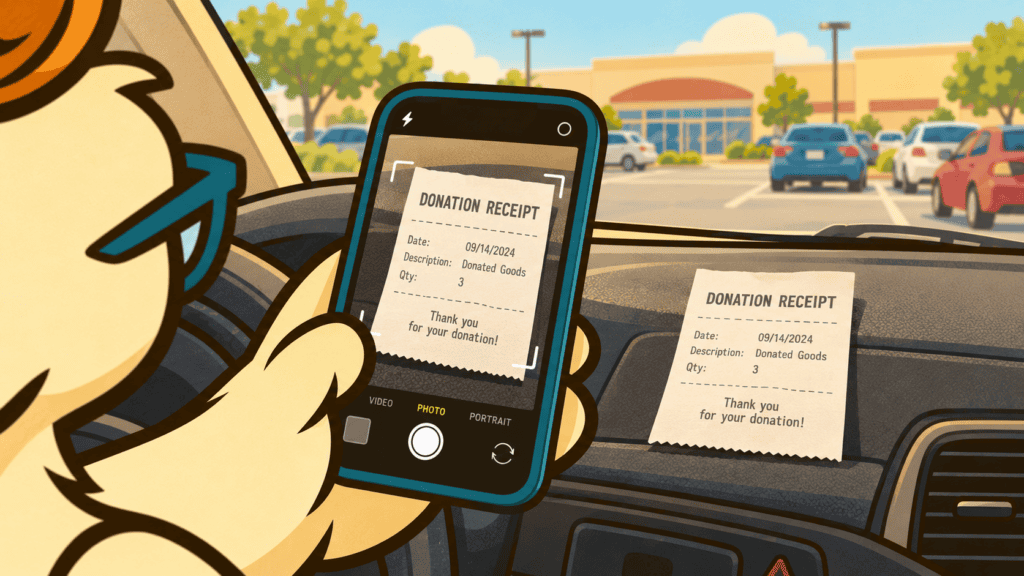
- Log it before you leave the parking lot, while the details are fresh. It takes about two minutes on your phone.
- Take a photo of the receipt and the items. A picture settles a lot of questions later.
- Pick one day a month, like the first Sunday, and scan your bank and card activity for charity gifts you haven’t logged.
- Keep everything in one place, because it’s hard to total records that live in a drawer, an inbox, and a phone.
Four ways to track charitable donations
Most people end up using one of these four methods:
| Method | What’s good about it | Where it falls short |
|---|---|---|
| A shoebox of receipts | Free and simple | No values, easy to lose, and you still add it all up in April |
| A spreadsheet | Free, and you control it | You look up every value yourself and keep the receipts somewhere else |
| A notes app or phone photos | Always with you | Hard to total, hard to sort by year, easy to delete by accident |
| A donation tracker | Values, receipts, and totals in one spot | Costs a little, and you need to pick one you trust |
A spreadsheet works fine for cash gifts. But donated items are where it gets painful. Every shirt, lamp, and blender needs a fair value, and looking those up one at a time gets old fast. So a tracker does that part for you.
Start Tracking Your Donations Now
Enter those valuable donations year-round and export an IRS-friendly report when you’re ready to file, just like ItsDeductible. Only $29.99/year
How Deductible Duck tracks your donations
We built Deductible Duck after Intuit shut down ItsDeductible, as a replacement for the people who relied on it every year. Since then, more than 20,000 people have used it to track their giving.
What it does:
- Pick what you gave from our item list and the app shows a fair value for it. Our values come from resale and thrift-store pricing from trustworthy sources, and a person checks them.
- Each item shows a high and a medium value, so you can match the value to the item’s condition. There’s no low value, because items worn past good used condition aren’t deductible.
- When you’re on a paid plan, you can snap a photo of a receipt with your phone and attach it to the donation.
- Cash, stock, and mileage also go in the same place as your items.
- Your running total for the year is always on screen.
- At tax time, export to TurboTax in a few clicks, or print a report for your tax preparer. It works for federal and state returns.
- Coming from ItsDeductible? You can import your old data in one sitting.
It runs in any web browser, and you can add it to your phone’s home screen so it opens like an app.
It’s free for your first $1,000 in donations, with no credit card needed. After that it’s $29.99 a year.

How to track charitable deductions if you didn’t track this year
Maybe it’s already fall and you haven’t logged a thing. You can still rebuild most of the year in an evening or two.
- Start with your bank and card statements. Search for church and charity names. Every hit is a cash gift you can log. If you’re not sure a group qualifies, look it up in the IRS Tax Exempt Organization Search.
- Search your email for words like “receipt,” “donation,” and “thank you.” Since most online gifts send an email receipt, this step often turns up a lot.
- Ask your church or charity for a year-end statement. Many send one in January anyway, and it lists every gift they recorded.
- Check your phone’s photos. You may have snapped a Goodwill receipt or a picture of the boxes before you dropped them off.
- Rebuild item donations as honestly as you can. List what you remember giving, with dates if you have them, and use values for items in good used condition.
Once you catch up, switch to the log-it-now habit. Then next year gets much easier.
Reasons to track that have nothing to do with April
Tax savings are why most people start tracking. They keep doing it for other reasons too.
You see what you actually give
Most people have no idea what their yearly total is until they track it. Seeing that your family gave a few thousand dollars in clothes, food, and cash over a year feels good. It also helps you plan next year’s giving.
Your family can find everything
If your spouse or kids ever need to handle your taxes, one tidy record is a lot kinder than a drawer full of receipts.
You can plan for big years
Downsizing or clearing out a parent’s house can add up to thousands of dollars in donated goods in a single year. Some people also group two years of giving into one year so they get over the itemizing line. Both only work if you know your numbers.
You’re ready if the IRS asks
With good records, a question from the IRS turns into a short, boring conversation.
A simple routine that works
- Right after you donate, log it and snap the receipt.
- Once a month, scan your bank and card statements for charity gifts.
- Every December, check your yearly total and decide if a year-end gift makes sense.
- At tax time, export your report and file.
A few minutes a month keeps your charitable deductions ready for tax time.
Start Tracking Your Donations Now
Enter those valuable donations year-round and export an IRS-friendly report when you’re ready to file, just like ItsDeductible. Only $29.99/year